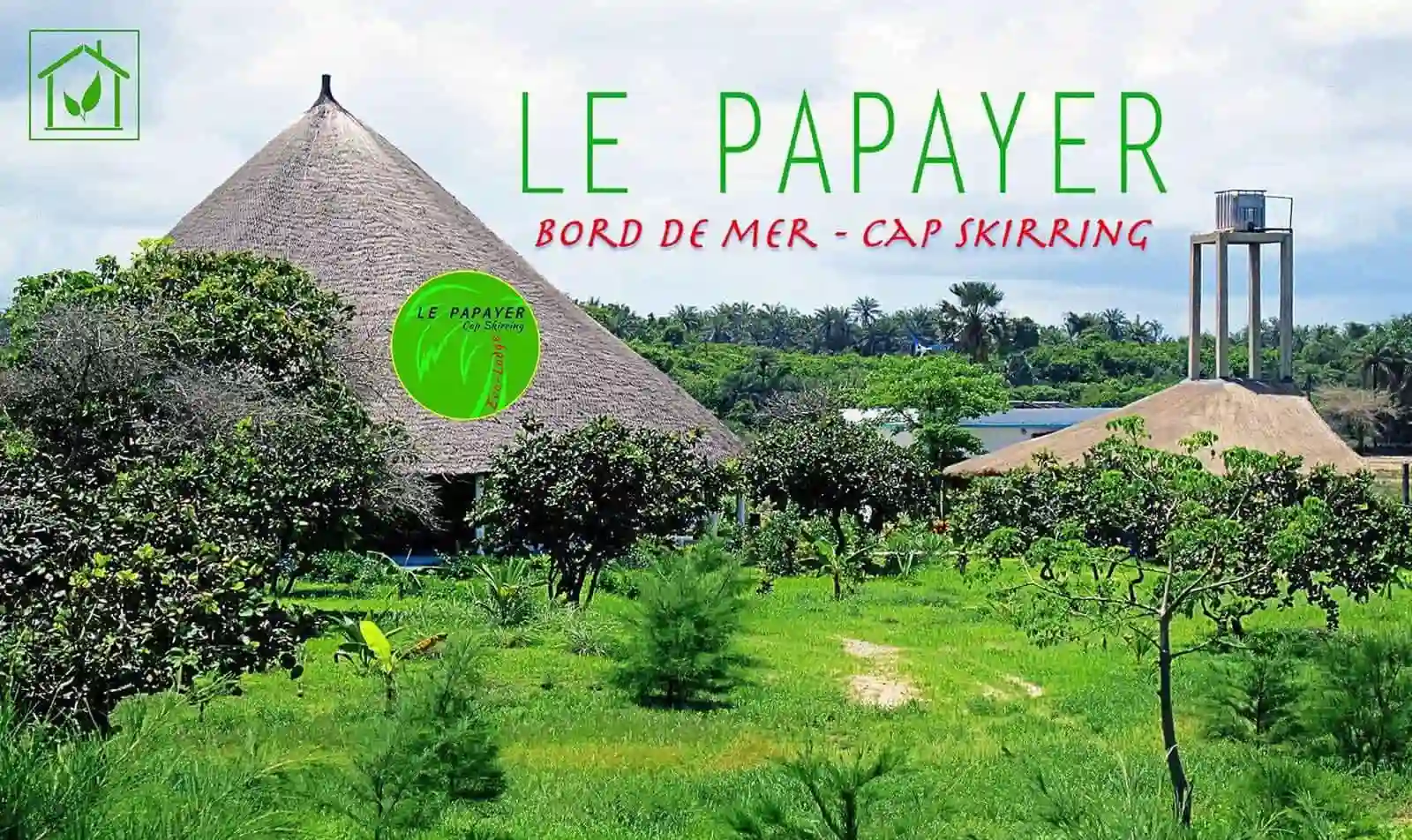
Our Quality Charter – Le Papayer Ecolodge Cap Skirring (Senegal)
Sustainable & Responsible Eco-Tourism in Casamance
Our Commitments to Comfort, Charm, and Environmental Respect
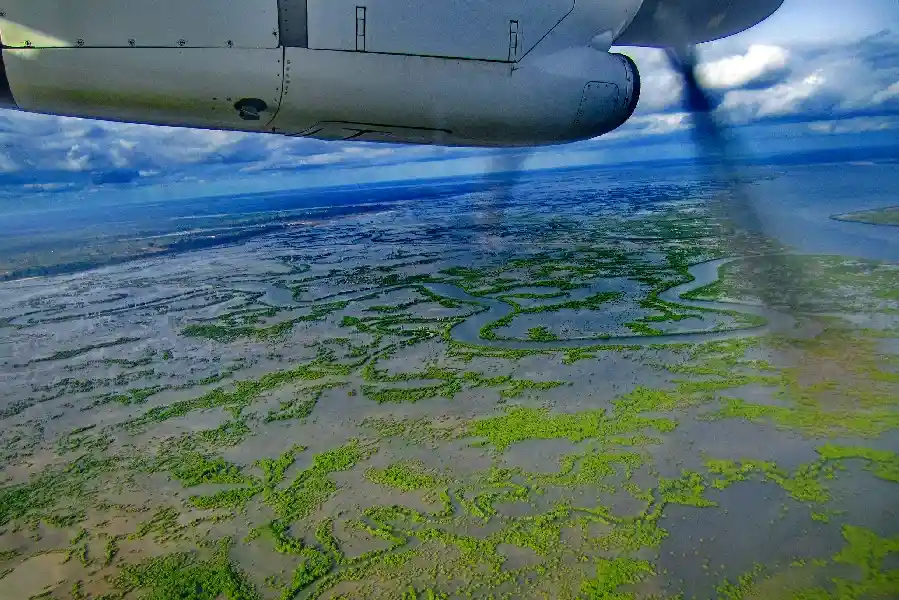 The travel guideDiscover CasamanceNature, mangroves, Jola culture, traditions and tips to prepare your stayRead the full guide →
 Plan your tripWhen to visit Casamance?Climate, sea and wind month by month in Cap Skirring: pick the season that suits youSee the monthly guide →
 Book your stay at Le Papayer EcolodgeNow that you have read their stories, plan your own stay and explore the soul of southern Senegal: accommodation, excursions, local cuisine and relaxing on the beaches of Cap Skirring.Book your stay
Discover the Papayer Ecolodge Forest in Casamance
In Cap Skirring, discover the Papayer Ecolodge Forest, its seafront hectare and its planting area. Virtually plant a tree or a flower and explore our approach to preserving life and biodiversity in Casamance.
DISCOVER THE PAPAYER ECOLODGE FORESTThere, all is order and beauty, luxury, calm and voluptuousness.
Updated on
Le Papayer Ecolodge Beach Hotel in Cap Skirring is part of the local authorities’ eco-responsibility drive. Our one-hectare wooded estate by the sea is first and foremost an ecological site: a refuge for biodiversity in Lower Casamance. Faced with the climate emergency, we run a concrete model of ecotourism in Senegal. Our internal self-assessment, carried out point by point against the Green Key checklist we consulted, found that we meet 100% of the criteria examined. This is a voluntary exercise, not a certification.
Our commitment translates into concrete, everyday actions. Since the project began, we have transformed a barren stretch of land into a thriving forest ecosystem by replanting over 250 trees and native plant species. Today, our eco-friendly hotel in Cap Skirring operates with no connection to the public grid (100% off-grid), powered by a mix of solar and wind energy. To protect the purity of the groundwater and the Atlantic Ocean right on our doorstep, our facilities meet the strictest European standards: we ban the use of any polluting chemicals and provide eco-friendly alternatives on-site.
Our Quality Charter aims to foster virtuous, ethical, and sustainable tourism development in Casamance. We are committed to providing an exceptional setting that combines comfort and modernity with a near-zero carbon footprint. This philosophy extends to our organic and locally sourced dining options, which rely on ultra-short supply chains established through close collaboration with market gardeners and fishermen from neighboring villages (Diembering, Boukot, and Cabrousse). By staying with us, you directly contribute to protecting this fragile, pristine environment and actively support a circular, fair, and socially responsible economy. To discover the place, its presentation, photo gallery and online booking, visit the home page of our ecolodge in Senegal.
The charter in numbers
- 250+trees and plants replanted
- 1 haseafront estate
- 24/7solar + wind, 100% off-grid
- 4neighbouring villages: Diembering, Boukot, Cabrousse, Cap Skirring
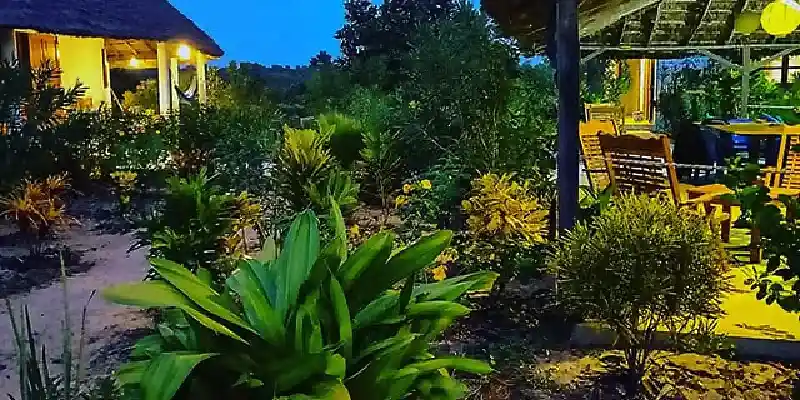
Frequently Asked Questions: Our Commitment to the Environment
How does Le Papayer Ecolodge protect the environment in Cap Skirring?
Our estate is first and foremost a genuine ecological site dedicated to biodiversity conservation, rather than merely a tourist destination. We operate entirely off-grid, powered by a mix of solar panels and wind turbines. We practice waste sorting and natural composting, and have replanted over 250 trees. The use of chemical detergents and laundry products is strictly prohibited to protect the groundwater.
Where do the meals served at the Ecolodge come from?
Food self-sufficiency is a priority for us. The food served is 100% organic and sourced through ultra-short supply chains. We work directly with small-scale market gardeners and fishermen from neighboring villages (Diembering, Boukot, Cabrousse). We also cultivate our own vegetable garden and fruit trees on-site, without the use of any pesticides or chemical fertilizers.
What is the impact of Le Papayer Ecolodge on the local economy in Casamance?
We have established a model that is both economically viable and socially equitable. All development and maintenance work is carried out by local artisans paid above the regional average. Furthermore, we share our innovations—such as the construction of solar ovens—with surrounding villages to combat deforestation caused by the use of firewood.
What are the standards for your installations (water, electricity)?
Although situated amidst the natural landscape of Casamance, the site offers optimal modern comfort. All our facilities (water management, eco-friendly septic systems, and solar and wind power) meet the strictest European standards, thereby ensuring safety, comfort, and absolute respect for the local ecosystem.
Our Quality Charter in detail
History of the place, local sharing, projects, environment, food and benefits for Casamance: discover our commitments one by one.
History of Le Papayer Ecolodge Hotel Cap Skirring Senegal
Originally, the land of Le Papayer Ecolodge hotel was only a strip of land between sea and rice field which only served the inhabitants of the surrounding villages to harvest firewood to cook. Over time, these samples have made the forest disappear. Since the start of construction in 2015/2016, The Ecolodge hotel has replanted many trees, plants and flowers ... around 250 on this one hectare site. Nature has taken back its rights. The stake was to safeguard and preserve this exceptional environment and its eco system to offer our guests an exceptional setting with all the necessary comfort and modernity. The constructions of the Ecolodge hotel meet European standards: electricity, septic tank, water supply and management, waste management. Today the bet has been taken to propose a quality accommodation in perfect harmony with our environment.
Opportunities and sharing at Papayer Ecolodge
There are many exchanges between Le Papayer Ecolodge hotel and the surrounding villages, Diembering, Boukot, Cap Skirring, Cabrousse. The food autonomy of Le Papayer Ecolodge hotel is mainly ensured thanks to small market gardeners and local fishermen. The maintenance of the hotel, the site and its improvement involve craftsmen from the villages: carpenters, masons, painters, electricians, but also artists for entertainment and shows: musicians, dancers, ... These exchanges make it possible to raise awareness of the "finite" resources that nature offers permanently and without taking into account that it is now necessary to preserve: creation of solar cookers, water conservation, counterproductive use of detergents and washing powders. The hotel's solar-wind mixture that we have implemented ensures our autonomy and is the subject of regular visits by the authorities and the owners of surrounding hotels and camps.
Papayer Ecolodge development projects
What follows describes projects that are under way or planned: they are not yet part of what exists today.
Le Papayer Ecolodge beach hotel Cap Skirring is investing in the installation of solar ovens, the popularization of their manufacture and use in villages to avoid cutting the firewood. The installation of a second wind turbine at Le Papayer Ecolodge hotel will raise awareness and ensure that our energy is supplied to neighboring structures. The ramp-up of Le Papayer Ecolodge hotel nursery will make it possible to offer solutions for reforestation of species in cleared areas. Awareness of the dangers of using polluting products and the proposal of substitute products to preserve the ecosystem. Preserving water through the establishment of a Optimal and controlled sprinkler system.
Energy: solar and wind
Le Papayer is not connected to any public grid and runs without a generator. Here is how energy is produced, stored and monitored, and what its limits are. The full story is in Off-grid ecolodge: how it works.
- Production: solar is the main source: two separate solar fields, each wired to an MPPT controller, with a switchover from one to the other. An iSTA Breeze Air Speed 24 V wind turbine complements it, mostly at night and in grey weather when solar produces little; a diversion load (800 W dissipation) removes surplus energy when the batteries are full.
- Storage: eight Luminous 12 V 240 Ah lead-acid batteries, wired as a 24 V bank and balanced in pairs (Victron Battery Balancer). A LiFePO4 lithium battery has been on trial for less than a year in a small beach house, before any wider rollout.
- Distribution: two separate Victron inverters, one for the accommodation and one for the pump and garden, so that the pump’s start-up surges do not disturb the lighting. Outdoor lighting runs on 12 V low-voltage DC: no 220 V in the garden.
- Redundancy: nothing relies on a single component. Two solar fields with two controllers and a switchover, two separate inverters, eight batteries in four parallel branches, remote monitoring. The wind turbine has two independent brakes: a manual brake, and an automatic brake that triggers within 0.1 second in case of overspeed; the latter is powered by the battery so that it acts even if the main circuit is cut. A surge arrester and a fuse complete the protection. The principle: when off-grid, you are your own backup service.
- Monitoring: battery charge, production and consumption are monitored remotely (Victron VRM system and a Raspberry Pi 4).
- Sobriety: we choose equipment with low idle consumption. We only ask guests to switch off the light when leaving the room and to leave very high-power appliances, such as large hair dryers, at home.
- Limits: total autonomy does not exist: we depend on sun, wind and imported parts. The equipment carries a manufacturing and transport carbon debt; by our own calculation, reaching a −80% footprint would take more than fifteen years, which is the equipment’s lifespan. Wind remains a complement whose real benefit we keep monitoring.
Redundancy diagram: solar, inverters and pumping
Swipe the diagram to see all of it.
- An MPPT fails: the other solar field keeps charging the bank, because both controllers feed the same batteries.
- The ecolodge inverter fails: a manual switch supplies the ecolodge from the pumping inverter.
- The sun is short: the wind turbine, independent of the solar chain, charges the same bank through its own circuit, with its brakes and diversion load.
- Nothing is invisible: a Raspberry Pi 4 running Venus OS monitors batteries, production and consumption remotely, so a fault can be seen coming.
- Lightning: surge arresters protect the wind turbine and the battery bank; garden lighting runs on safe 12 V (24 → 12 V converter, 280 W), with no 230 V in the garden.
Environmental protection at Papayer Ecolodge
The mixed solar + wind energy of Le Papayer Ecolodge hotel powers the whole site with no connection to the public grid and no generator: no noise pollution, day or night. Intelligent waste management and plastics: sorting, compost ... ensures the protection of the water table with the ban on the use of soaps, mushrooms, washing powders and polluting detergents (replacement by substitute products provided on site). The creation of solar ovens makes it possible to limit the cutting of bush wood. Preservation and control of the use of fishery resources (watering, shower, WC) allows us to control our water dependence. The development of the nursery, vegetable garden and fruit trees of Le Papayer Ecolodge hotel makes it possible to raise awareness of natural composting techniques ...
Quality of food at Papayer Ecolodge
The food is organic by definition, the supply is local. No pesticides, fertilizers or chemicals are used at Le Papayer Ecolodge hotel. The equipped kitchen of Le Papayer Ecolodge hotel allows you to cook according to your desires and habits: European cuisine but also specialized African: Tieboudien, tiebouyab, Caldou, Kandia soup, mafé, grilled fish. An excellent cook is available. African specialty specific to the hotel's ecosystem: “Tiapettes”, small fish that are found in the rice fields during the rainy season. The sea, facing Le Papayer Ecolodge hotel allows you to feed on a wide variety of fish: captains, barracudas, etc. The garden of Le Papayer Ecolodge hotel, vegetable garden and fruit trees are also welcome: tomatoes, bananas, watermelons, lemons, grapefruit, coconut ... Nature is very prolific and generous.
Socio-economic benefits in Casamance
All the fittings and work carried out at Le Papayer Ecolodge hotel involve craftsmen from the surrounding villages. The wages paid to these craftsmen are more higher than the local average. We have at our disposal a pool of craftsmen and artists that we regularly involve for the decoration, maintenance and animation of Le Papayer Ecolodge hotel. Our economic model allows us to experiment with an ecologically sustainable approach, but also and above all economically viable, while being socially fair and ethically fair. It is fundamental that all the actors can find their way around and work in a innovative and positive state of mind. The welcome of our guests and the quality of services offered at the hotel go hand in hand with this state of mind.
Our proof
What we say on this page can be checked: here is where to look.
Guest reviews
4.7/5 · 53 Google reviews
Read the reviews →The Papayer forest
More than 250 trees and plants replanted on the one-hectare estate
See the forest →Off-grid ecolodge: how it works
Sun, wind, water, waste: how the place runs day to day
Read our story →Photos of the estate
The estate, the beach and the rooms in pictures, taken on site
See the photos →Documentary film
“Poisson d’or, poisson africain” (Thomas Grand, Moussa Diop) on fishing in Casamance, featured in our fishing dossier
See the fishing dossier →Green Key checklist
Our internal self-assessment relies on this reference checklist (voluntary, not certified)
View the checklist →Going further: our features on Casamance
Understand the region beyond the ecolodge — fishing, biodiversity, mangroves and forests.
🎣 Fishing in Casamance
Artisanal fishing and major centres, the fisheries crisis and marine protected areas.
🐢 Ecological protection & biodiversity
Ecosystems, protected areas and conservation strategies for a biodiversity unique to Casamance.
🌊 The mangrove & the bolongs
Mangrove trees, fish nursery, threats and replanting of this vital ecosystem.
🌳 Forests & wood species
Exceptional flora, protected forests and sustainable management of forest resources.

Reviews Le Papayer Ecolodge hotel Cap Skirring
Charter Le Papayer Ecolodge hotel Cap Skirring
Brochure Le Papayer Ecolodge hotel
Welcome Booklet hotel Le Papayer Ecolodge
Casamance Excursions Cap Skirring
Kitesurf Le Papayer Ecolodge hotel Cap Skirring
RGPD Le Papayer Ecolodge hotel Cap Skirring
The spirit of Papayer Ecolodge
We look forward to welcoming you to Cap Skirring Casamance Senegal
Hotel Story
Le Papayer Ecolodge
Le Papayer Ecolodge beach hotel Cap Skirring welcomes you in an exceptional setting on the seaside in Cap Skirring Casamance in southern Senegal.
One hectare wooded garden, direct access to the beach, responsible eco tourism, "à la carte" Casamance safari excursions, ... Feet in the water on one of most beautiful beaches in Senegal at Cap Skirring.