Energy · Self-sufficiency · Live monitoring
Solar energy at Le Papayer Ecolodge, live
At Le Papayer Ecolodge in Cap Skirring, electricity comes from the sun and sleeps in batteries: we are not connected to any public grid. Here is, in real time, what our two Victron installations produce and store, and how they work.
Main system
The main system, live
This dashboard comes from our Victron monitoring (the VRM portal). The cards below update every minute; Victron's detailed chart, just underneath, shows the history of the last hours and days. The page is read-only: you can look, nothing else.
Loading measurements…
Beach system
The beach cabin: a lithium system on trial
On the beach, a small house has its own installation, independent of the first one. It is our test bench: a 25.6 V, 100 Ah lithium iron phosphate (LiFePO4) battery, a 150/35 MPPT solar charge controller and a Phoenix 24/1200 inverter. It has been running for less than a year; we are observing how it behaves before considering wider use.
Loading measurements…
Principle
How it works
From the panel to the socket in your room, energy goes through five stages. Each one appears in the dashboard above.
- Production.
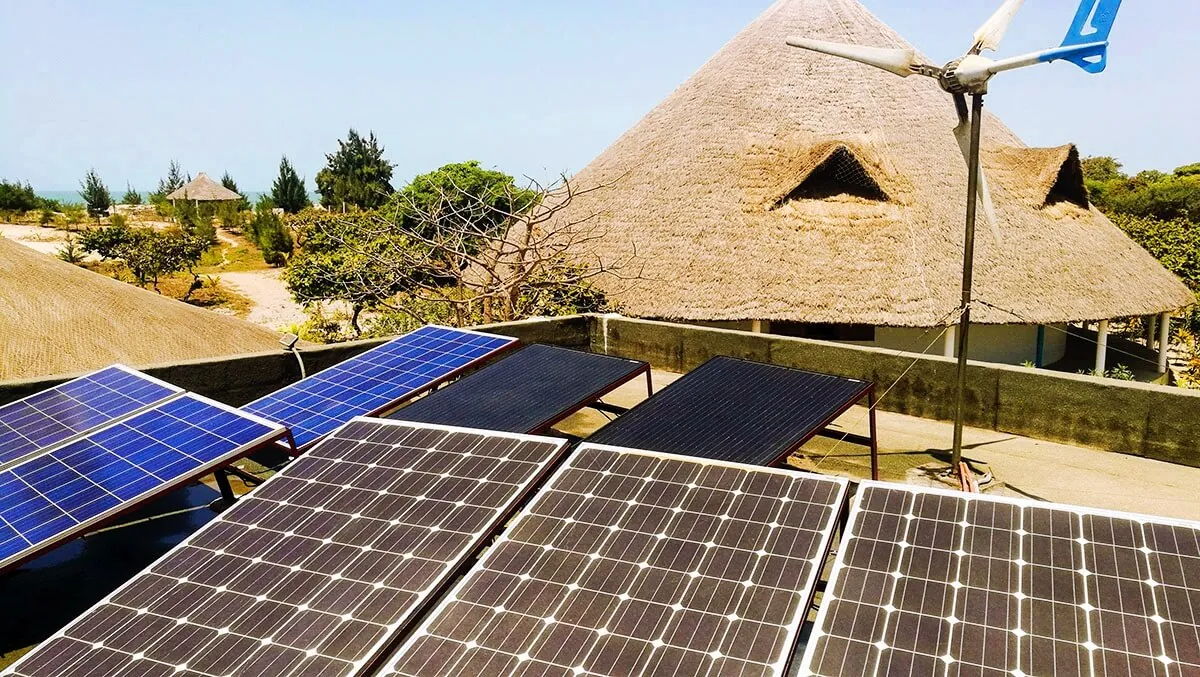
Our panels total 7 kW, split into two separate arrays. Each array has its own Victron MPPT charge controller (150/85 and 150/45), which extracts the maximum power from the sun and turns it into current suited to the batteries. A wind turbine is planned as a complement, for the night and grey weather: it is not installed yet.
- Storage.
Eight 12 V, 220 Ah tubular lead-acid batteries are wired as 24 V, in four parallel strings: 880 Ah in total. Victron balancers make sure they charge evenly.
- Conversion.
Two Victron Phoenix inverters turn the batteries' 24 V DC into 220 V AC: one 3,000 VA unit for the accommodation, one 1,200 VA unit for the water pump and the garden, so that the pump's start-ups do not disturb the lighting. An Orion-Tr converter supplies 12 V for low-voltage uses.
- Measurement.
A Victron battery monitor (BMV-712) measures at every moment what goes in and what comes out, and deduces the state of charge.
- Supervision.
A Victron GX device, installed on a Raspberry Pi 4, gathers all these measurements and sends them to the VRM portal, where this page's dashboards come from.
Hot water in the bathrooms comes from a 150 L solar water heater that uses no electricity. There is no air conditioning at Le Papayer.
The installation in numbers
Reading the live dashboard
- By day: solar production rises with the sun, powers the lodge and recharges the batteries. Clouds make it fluctuate.
- At night: the panels no longer produce, everything comes from the batteries. Their state of charge drops gently, carried by the fridge, the freezer, the router and the lighting.
- The state of charge (in %) shows what is left in the batteries. We avoid deep discharges, to preserve them.
- Brief peaks in consumption are most often the water pump starting, which fills the garden reserve.
What this page does not say
The figures shown come from our equipment, as the Victron portal receives them: they may lag slightly, or stop if the lodge's internet connection is cut. Total self-sufficiency does not exist: we depend on the sun and on imported parts, and an off-grid site needs regular maintenance. Control and settings of the installation stay local and reserved for the team; this page only lets you look.
Going further
What does a stay off the grid look like?
Off-grid ecolodge: how it works
The full story of Le Papayer's self-sufficiency: energy, water, sobriety, limits.
Our quality charter
Our commitments, our proof, and what we do not promise.
The Papayer forest
The other half of our approach: planting trees, for real.
Want to stay in a sun-powered ecolodge?
Book at Le Papayer Ecolodge, by the ocean in Cap Skirring.
Book my stay