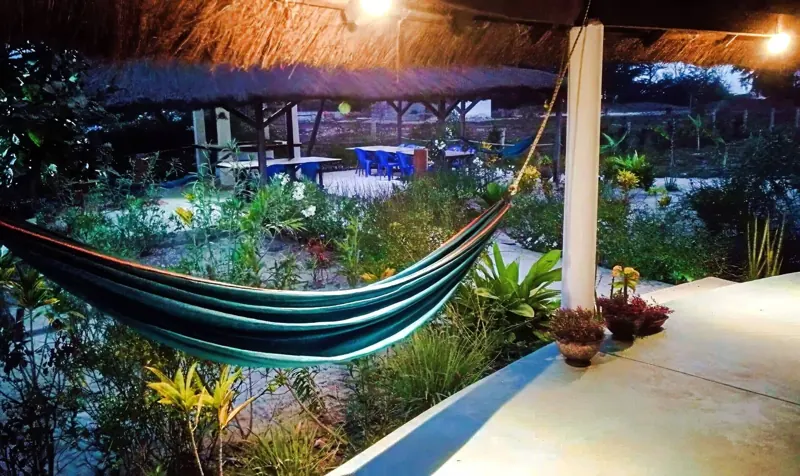
Le Papayer Ecolodge · Cap Skirring · Casamance · Senegal
When to visit Casamance, Senegal? The month-by-month calendar
Rain, sun, wind, sea, humidity, crowds and nature: choose your dates with full knowledge of the facts.
Casamance, in southern Senegal, has two faces: a bright dry season, generally from November to May, and a green, rainy season from June to October. In between, each month has its own colour: the cooler sea of February, the mangoes of May, the baobab flowers in June, the sea turtles of summer, the migratory birds of November. This page brings together, month by month, figures from measuring stations and the calendar of living nature from our dossiers, so you can choose your dates with full knowledge of the facts.
The current month is highlighted automatically. To prepare your stay, also see our complete guide to Casamance.
In short: the dry season (generally from November to May) is the most favourable, especially from November to April, in Cap Skirring if you are looking for sun and no rain; the cool season (November to February-March) is also the busiest. From June to October, the rainy season brings rain, humidity and intensely green nature, with almost no visitors: it is the season of those who love Casamance. The best month then depends on your priorities (beach, kitesurfing, birds, excursions, local life): use the period selection tool.
Part 1ChooseFind the right time for you
Find your ideal period
The best time to come to Casamance, in Senegal, depends on what you are looking for: beach and sun, kitesurfing, birds, village festivals, mangoes, green landscapes, or on the contrary calm and authenticity. Choose one or more interests, or set your own criteria (from “a plus” to “essential”), and the page ranks the 12 months for you.
Step 1 · Your profile and interests
Tap one or more interests: your criteria are combined (the highest level is kept).
Choose at least one interest or criterion to see the ranking of the months.
⚙️ Step 2 · Fine-tune your criteria (optional, 16 criteria adjustable one by one)No criteria selected
For each criterion, indicate its importance: None (ignored), A plus, Important or Essential (rules out the months that do not suit).
How is the ranking calculated?
Each criterion gives each month a score from 0 to 1. A month's score is the average of the scores of your criteria, weighted by their importance (a plus = 1, important = 2, essential = 3), brought to a scale of 100. The result does not take prices into account: see the average daily budget further down. An “essential” criterion rules out months whose score is below 0.35. The result is indicative: it takes into account neither prices nor availability.
The 12 months in one table
The values are averages over several years. Click on a month to read the details. Very favourable marks the driest and most pleasant months for the beach and excursions (wind is assessed separately, in the “Wind” section); Rainy season the months with frequent rain (16 to 19 days of rain per month from July to September). This ranking is our reading of the figures, not a measurement.
| Month | Rain (mm) | Rainy days | Sun (h/day) | Max / min (°C) | Sea (°C) | Crowds | Average wind (knots) · direction | Our reading |
|---|---|---|---|---|---|---|---|---|
| January | 0 | 0 | 8.5 | 31.8 / 17.9 | 23 | Fairly busy | 7 · NNE | Very favourable |
| February | 0 | 0 | 9.5 | 32.6 / 18.3 | 22 | Busy | 8 · NNE | Very favourable |
| March | 0 | 0 | 10 | 31.9 / 19 | 22 | Fairly busy | 7 · NNW | Very favourable |
| April | 0 | 0 | 10 | 30.1 / 19.9 | 22.5 | Busy | 7 · NW | Favourable, more humid, milder nights |
| May | 3 | 0.4 | 9.5 | 30 / 21.9 | 24.5 | Quiet | 6 · NW | Favourable, before the rainy season |
| June | 49 | 4.4 | 8.5 | 31.4 / 24.4 | 27.5 | Quiet | 6 · WNW | Start of the rainy season |
| July | 309 | 15.6 | 6.5 | 30.9 / 24.5 | 28.5 | Quiet | 6 · W | Rainy season: frequent rain |
| August | 432 | 19.1 | 6 | 30.5 / 24.3 | 28 | Quiet | 6 · WSW | Rainy season: the wettest |
| September | 318 | 15.8 | 7 | 31.2 / 23.8 | 28.5 | Quiet | 5 · WSW | Rainy season: frequent rain |
| October | 102 | 7.6 | 8.5 | 32.4 / 24.2 | 29 | Quiet | 5 · WNW | End of the rainy season |
| November | 2 | 0.3 | 9 | 32.8 / 22.3 | 28 | Fairly busy | 5 · N | Very favourable |
| December | 0 | 0.1 | 8.5 | 32 / 19.1 | 26 | Busy | 7 · NNE | Very favourable |
Rain, rainy days and temperatures: 1991-2020 normals from the Cap Skirring station. Sun: Ziguinchor station, the nearest. Sea: Cap Skirring averages. Wind: Cap Skirring airport station. Crowds: estimate based on our experience of the place (not an official statistic). Details of the sources below.
These figures are climate averages and historical observations, from different sources and periods depending on the indicator: they describe usual trends and are not a forecast for your dates. A “0 mm” is a rounded monthly average: an exceptional shower remains possible, even in the middle of the dry season.
Part 2UnderstandSeasons, month by month, and wind
High season, low season and rainy season: each to their own Casamance
The cool season and the high season
The cool season (from November to February-March) is the most sought-after by visitors: the temperature is ideal for Europeans. Crowds are at their highest around Christmas and New Year, then during the French school holidays: February and Easter holidays. Even between these peaks, crowds remain fairly high to moderate throughout the cool season: the real lulls are found mostly outside this period.
The hot season and the rainy season
The hot season and the rainy season are the periods when there is almost no one around. For many visitors, this is a drawback; for true lovers of Casamance, it is a quality. Tourism stops, and time with it: people live day to day, to the rhythm of the rains, and it is hard to make forecasts. In exchange, the colours and nature are simply extraordinary. Conversely, it is a demanding period: rain, humidity, reptiles after the showers.
Humidity: nothing really dries
Humidity is very high during the rainy season (around 80 to 85% from July to October). In practice, nothing really dries: laundry, shoes and belongings always stay damp. Small wounds (cuts, grazes, scratched bites) can also turn into a real problem if they are not treated quickly and properly: clean and disinfect them straight away, keep them clean and protected, and see a doctor if they redden, swell or do not heal. For this general advice, ask your doctor or a pharmacist before departure.
The momentum of local life
The momentum of local life follows the same curve: very strong during the cool season, which is the tourist period, with shops and services open. It drops as the rainy season approaches: shops closed, activity reduced to a minimum, travel difficult during the rains. This is what a tourist may hate, and what true lovers of Casamance come looking for. Two filters of the mini expert system let you choose one or the other.
The “Crowds” column of the table is an estimate based on our experience of the place, not an official statistic: it varies from year to year and with holiday dates.
Month by month: weather and the calendar of living nature
Figures for the month, atmosphere and nature, based on our dossiers on fishing, the mangrove, wood species and ecological protection
The markers of living nature are indicative: they rely on local observation and published surveys, and nature always keeps its share of the unexpected. When a fact is given for an entire season (for example from November to January), it is repeated in each of the months concerned.
January in CasamanceVery favourable
- 0 mm of rain · 0 d
- 8.5 h of sun/day
- 31.8 / 17.9 °C max / min
- Sea 23 °C
- Humidity 58 %
- Crowds Fairly busy
- Local life Very lively
- Wind 7 kts (NNE)
The heart of the dry season: no rain on average and the coolest nights of the year (17.9 °C average minimum). The north-east trade winds set in, which kicks off the kitesurfing season, from January to April.
It is the time of the rice harvest and harvest festivals. Migratory birds are here: pelicans, flamingos, storks and wild ducks. You can taste wild fruits such as ditakh and the baobab monkey-bread fruit. At sea, catches of bonga shad (cobo) are large from January to August, and round sardinella is abundant during the cool season. In the bolongs you may spot the manatee and the pied kingfisher, while the mangrove oyster harvest is in full swing.
February in CasamanceVery favourable
- 0 mm of rain · 0 d
- 9.5 h of sun/day
- 32.6 / 18.3 °C max / min
- Sea 22 °C
- Humidity 61 %
- Crowds Busy
- Local life Very lively
- Wind 8 kts (NNE)
The water is at its coolest (22 °C) and, at the airport station, this is the windiest month of the year (8 knots on average, with 11% of the time between 7 and 22 knots). February and March are the best months for kitesurfing.
The dry season settles in: harvest under the cashew trees (nuts and cashew apples), black tamarind (sol), palmyra palm fruit and oil palm bunches. At low tide, fiddler crabs and mudskippers bring the mudflats to life under the gaze of sacred ibises and spoonbills, while Nile monitors and crocodiles warm up on the banks. Shrimp have a second fishing period around February-March, and the small black carp (wass), the basis of the real caldou, is abundant in the bolongs.
March in CasamanceVery favourable
- 0 mm of rain · 0 d
- 10 h of sun/day
- 31.9 / 19 °C max / min
- Sea 22 °C
- Humidity 68 %
- Crowds Fairly busy
- Local life Very lively
- Wind 7 kts (NNW)
The sunniest month (about 10 hours of sun a day) and still no rain. Nights remain mild (19 °C) and the sea is still cool (22 °C). The wind is still good for kitesurfing.
The dry season continues: cashew, black tamarind, palmyra palm and oil palm. The surveys of the Niamone-Kalounayes marine protected area show a strong presence of threadfin (capitaine), large-scaled mullet and sea pike in March-April. Shrimp have their fishing window from March to April. On the banks, ibises, spoonbills, monitors and crocodiles can be observed, and amaranth and the hoopoe enliven the gardens.
April in CasamanceFavourable, more humid, milder nights
- 0 mm of rain · 0 d
- 10 h of sun/day
- 30.1 / 19.9 °C max / min
- Sea 22.5 °C
- Humidity 75 %
- Crowds Busy
- Local life Very lively
- Wind 7 kts (NW)
The end of the dry season: still no rain, but the air is more humid (75% humidity on average) and nights are milder (19.9 °C average minimum). Vegetation suffers from the water deficit and some trees shed their leaves to limit water loss.
Cashew trees, tamarind, black tamarind, palmyra palm and oil palm set the rhythm of the landscape. The giant tiger shrimp starts to become abundant in the estuary (April to June, varying from year to year), and white shrimp are still fished in March-April. At low tide, the pneumatophores of the black mangroves emerge clearly from the mud, and more rarely you may come across the humpback dolphin in the estuary.
May in CasamanceFavourable, before the rainy season
- 3 mm of rain · 0.4 d
- 9.5 h of sun/day
- 30 / 21.9 °C max / min
- Sea 24.5 °C
- Humidity 78 %
- Crowds Quiet
- Local life Lively
- Wind 6 kts (NW)
Before the rainy season, nights are warmer (21.9 °C average minimum) and it feels more humid; the first drops fall (3 mm on average). The wind weakens: the kitesurfing season ends.
Peak season for mangoes, picking of wild madd, fresh palm wine and the appearance of the ritual Kumpo mask. Flame trees, baobabs and kapok trees are in bloom. In the canopy, the red-billed hornbills, the fish eagle, the Abyssinian roller and green monkeys are active. Reptiles wake up (green mamba, pythons). At sea, bonga shad is very present in May-June and the large pelagics (yellowfin, bigeye, skipjack) appear offshore from May to October.
June in CasamanceStart of the rainy season
- 49 mm of rain · 4.4 d
- 8.5 h of sun/day
- 31.4 / 24.4 °C max / min
- Sea 27.5 °C
- Humidity 78 %
- Crowds Quiet
- Local life Reduced
- Wind 6 kts (WNW)
The rainy season begins: 49 mm of rain on average, spread over about 4 days. The sea warms up (27.5 °C) and the landscapes turn from dry to green.
The baobab flowers around June: its large hanging white flowers open mostly in the evening and at night. Mangoes, madd and palm wine continue. Skipjack is still reported until June, the tiger shrimp remains present in the estuary, and the mangrove oyster harvest ends with the arrival of the rainy season. The first rains change the salinity of the bolongs and restart the vegetation.
July in CasamanceRainy season: frequent rain
- 309 mm of rain · 15.6 d
- 6.5 h of sun/day
- 30.9 / 24.5 °C max / min
- Sea 28.5 °C
- Humidity 82 %
- Crowds Quiet
- Local life Minimal
- Wind 6 kts (W)
Full rainy season (Wanaye): 309 mm of rain on average over about 16 days, and only 6.5 hours of sun a day. The forest becomes lush.
Work on the land sets the rhythm of the days: ploughing, transplanting and growth of rice, maize and groundnuts. Weaverbirds weave their hanging nests, showers trigger the flight of termites and clouds of butterflies, and the undergrowth teems with mushrooms. The great mango season peaks between July and September, and the madd season is open. In the Niamone-Kalounayes marine protected area, July is among the months with the greatest fish species richness. At night, sea turtles come to lay their eggs on the beaches, and fireflies light up the vegetation.
August in CasamanceRainy season: the wettest
- 432 mm of rain · 19.1 d
- 6 h of sun/day
- 30.5 / 24.3 °C max / min
- Sea 28 °C
- Humidity 85 %
- Crowds Quiet
- Local life Minimal
- Wind 6 kts (WSW)
The wettest month: 432 mm of rain on average, over about 19 days, with 6 hours of sun a day. Humidity is the highest of the year.
The rice fields in full growth form an emerald carpet, and the mangrove plays its role as a nursery: fresh water changes the salinity of the bolongs. Amphibians put on a thunderous concert at night and fireflies are numerous. Reptiles are in full swing (spitting cobra, puff adder): they come out mostly after a shower, when the sun returns. During the rainy season, you walk looking where you put your feet. Sea turtle nesting continues on the beaches.
September in CasamanceRainy season: frequent rain
- 318 mm of rain · 15.8 d
- 7 h of sun/day
- 31.2 / 23.8 °C max / min
- Sea 28.5 °C
- Humidity 84 %
- Crowds Quiet
- Local life Minimal
- Wind 5 kts (WSW)
318 mm of rain on average, over about 16 days. The rains begin to space out towards the end of the month.
In September, tradition resounds with the outings of the protective Kankourang mask. In the Niamone-Kalounayes marine protected area, it is the month of the greatest fish abundance and the greatest fish biomass. The peak landing of white shrimp begins (September to November). Mangoes, madd and rice continue their cycle, and sea turtles may still lay.
October in CasamanceEnd of the rainy season
- 102 mm of rain · 7.6 d
- 8.5 h of sun/day
- 32.4 / 24.2 °C max / min
- Sea 29 °C
- Humidity 81 %
- Crowds Quiet
- Local life Reduced
- Wind 5 kts (WNW)
The rainy season ends: 102 mm of rain on average over about 8 days. The sea is at its warmest (29 °C) and the days become sunnier again.
White shrimp is at its landing peak (September-November). In the Niamone-Kalounayes marine protected area, October is among the months with the greatest species richness. The rice fields are at maturity before the harvest, and sea turtles may still come to lay on the beaches. The landscapes are at their greenest.
November in CasamanceVery favourable
- 2 mm of rain · 0.3 d
- 9 h of sun/day
- 32.8 / 22.3 °C max / min
- Sea 28 °C
- Humidity 72 %
- Crowds Fairly busy
- Local life Lively
- Wind 5 kts (N)
The return of the dry season: 2 mm of rain on average, a still warm sea (28 °C) and bright days. The bolongs regain saltier water.
The rice harvest begins, with the harvest festivals, and the migratory birds arrive: pelicans, flamingos, storks, wild ducks. The fruits of the ditakh and the baobab monkey-bread are ripe. In high season, the harvest of mangrove oysters traditionally begins, and sardinella is abundant in the cooler waters. At low tide, fiddler crabs and mudskippers reappear on the mudflats.
December in CasamanceVery favourable
- 0 mm of rain · 0.1 d
- 8.5 h of sun/day
- 32 / 19.1 °C max / min
- Sea 26 °C
- Humidity 62 %
- Crowds Busy
- Local life Very lively
- Wind 7 kts (NNE)
No rain on average, nights getting cooler (19 °C) and golden landscapes. The trade winds return: the first kitesurfing rides can start as early as December.
Skipjack is reported from December, sardinella remains abundant and the mangrove oyster harvest continues. The surveys of the Niamone-Kalounayes marine protected area show strong diversity in December: 27 fish species were recorded in the surveys cited in our dossiers (an observation figure, which may vary from year to year). Migratory birds are still present on the mudflats and in the bolongs, and the rice harvest comes to an end.
The wind in Cap Skirring
The Cap Skirring airport station (observations from April 2010 to September 2026, according to Windfinder) gives an average wind of 6 knots over the year. It is strongest from December to April (7 to 8 knots), with a prevailing direction of north-north-east in December-January-February, which turns to the north-west and then the west-south-west during the rainy season. The wind is weaker from September to November (5 knots).
This station is located inland, at the airport: it underestimates the sea breeze that blows on the beach. In season, kitesurfers find north-east trade winds of 10 to 20 knots, with gusts up to 25 knots, from January to April (February and March at the top). The Harmattan, a dry wind from the desert, can exceed 30 knots.
Le Papayer Ecolodge welcomes experienced kitesurfers who travel with their own equipment (no lessons or rental). All the information on the spot, the season and the forecasts is on becapkite.com, the kitesurfing page for Cap Skirring.
Part 3PrepareExcursions, flights and budget
Where to go: the map of our excursions
Le Papayer Ecolodge, an ecolodge in Senegal facing the ocean in Cap Skirring, is your base camp: from here our excursions radiate towards the islands, the bolongs, the Diola villages and the markets. The precise programme is put together with you, according to the season, the tide and your wishes. Tap a point on the map to discover the excursion.
The destinations of our excursions, around Le Papayer Ecolodge (yellow dot). Base map © OpenStreetMap.
- Cap SkirringVillage, market & nightlife
- Carabane IslandThe island without cars
- Pointe Saint-GeorgesManatees & giant kapok tree
- OussouyeThe king & Diola traditions
- EnamporeThe impluvium house
- AffiniamGreat house & bolong
- ZiguinchorThe capital of the South
- Niomoune / Karone IslandsThe mystic archipelago
- DiembéringThe biggest kapok tree in Senegal
- EssaoutThe oyster village
- BoudédièteWild beach & open sea
How to get to Casamance: boat, flights and road by season
To reach Cap Skirring, in Senegal, the boat, the flights and the road are not equally available all year round: connections change with the season, which matters when choosing your period:
By air
🗓️ Offered in high season by Air CM, on Sundays and Wednesdays, from 18 October 2026 to 9 May 2027 (2026-2027 season).
🎫 Times and fares on capcasamance.com.
📈 Connections are at their most frequent. Until last season, Air Sénégal operated up to two flights a day (morning and afternoon), as Ziguinchor airport was closed.
🛫 The latter reopened on 1 May 2026: the pace of direct flights to Cap Skirring may therefore be lower.
🔄 The airline Transair is reorganising: flights remain possible, but with no more visibility for the moment.
📉 Service is reduced to about two flights a week with Air Sénégal from Dakar, on Wednesdays and Sundays.
By sea
🚢 Overnight crossing: departs Dakar on Tuesdays and Fridays in the evening (sailing around 8 pm), arriving in Ziguinchor the next morning, with a stop at Carabane.
↩️ In the other direction, it leaves Ziguinchor on Thursdays and Sundays in the early afternoon and reaches Dakar the next morning.
🛏️ Pullman seat or cabin depending on the class. From Ziguinchor, you then still need to reach Cap Skirring by road.
ℹ️ The ship stops for maintenance at certain times of year: timetable and booking on the Port of Dakar website.
By road
🚌 Bus: coaches link Dakar to Ziguinchor and Cap Skirring via The Gambia in a day (about 8 hours announced), but only on certain days of the week. Details on cap-skirring.voyage.
🚗 Car with driver: a more flexible option on timing, to be booked in advance.
🛂 The journey crosses The Gambia: bring your passport and allow time for border formalities.
⚠️ This information is indicative: days, times and fares change from one season to the next, and the boat has technical shutdowns. Check with the operator before booking.
What budget should you plan?
Casamance, in southern Senegal, remains a prized and little-known destination, and therefore relatively more expensive than mass-tourism destinations. To be comfortable on the spot (accommodation, meals, excursions and outings), allow on average €40 to €70 per day per person, excluding flights. This is a general guide for the destination, not a guaranteed rate or the price of a specific stay. Around €40 a day already gets you good accommodation and meals; at €70 a day, it is a very good budget that also lets you get around and do an excursion. The actual budget depends on the comfort chosen, the number of excursions and the length of the stay.
Indicative estimate, excluding flights: it does not replace a quote. Ask for a free quote to find out the exact price for your dates.
Part 4Check and go furtherQuestions, sources and dossiers
Frequently asked questions: when to go to Casamance?
Choosing the right season
What is the best time to go to Cap Skirring, in Casamance (Senegal)?
The dry season generally lasts from November to May; the most comfortable period for sun and beach runs from November to April: according to the Cap Skirring station normals, almost no rain falls between November and April (May stays dry, with only 3 mm on average, but is more humid and warmer at night), maximum temperatures stay around 30 to 33 °C and nights are mild to cool (18 to 22 °C). December to March is the heart of this period. For kitesurfing, the season runs from January to April, with February and March at the top.
When does it rain the most in Casamance?
From July to September: 309 mm in July, 432 mm in August and 318 mm in September on average, with 16 to 19 days of rain per month. June (49 mm) and October (102 mm) are transition months. From December to April, average totals are zero or almost zero.
Can you travel to Casamance during the rainy season?
Yes, if you accept living with the rain: the vegetation is an intense green, it is the season of mangoes, sea turtle nesting and mangroves in full nursery mode. You should, however, plan a flexible programme and check what is on offer at this time of year before booking.
What temperatures can you expect throughout the year?
Average maximums vary little, from 30 °C (April, May) to 33 °C (November). Minimums range from 18 °C in January-February to 24 °C from June to October. The sea is at 22 °C in February-March and rises to 28-29 °C at the end of the rainy season.
Life on the ground
What does humidity change in the rainy season?
It is very high from July to October (around 80 to 85% average humidity): nothing really dries and everything stays damp. Small wounds can become a real problem if they are not treated quickly and properly: immediate cleaning and disinfection, clean protection, medical advice if they redden, swell or do not heal. Ask your doctor or a pharmacist for advice before departure.
What happens to local life during the rainy season?
The momentum of local life is very strong during the cool season, which is the tourist period. It drops as the rainy season approaches: shops closed, activity reduced to a minimum, travel difficult during the rains. This is what some visitors dislike, and what true lovers of Casamance look for.
When is it busiest, and when is it quiet?
Crowds are at their highest during the cool season (November to February-March), especially at Christmas and New Year, then during the French school holidays in February and at Easter. Even between these peaks, crowds remain fairly high to moderate throughout the cool season. In the hot season and during the rainy season, there are almost no visitors: it is the preferred period of those who love everyday Casamance, with intensely green nature, but also the wettest.
Where can you find wind statistics for kitesurfing in Cap Skirring?
The Cap Skirring airport station (Windfinder) gives monthly statistics. It is located inland: on the beach, the sea breeze is stronger. In season, kitesurfers find north-east trade winds of 10 to 20 knots. See the spot page on becapkite.com.
Planning your trip
How much should you budget per day in Casamance (Senegal)?
Casamance, in southern Senegal, is a prized and little-known destination, relatively more expensive than mass-tourism destinations. To be comfortable on the spot (accommodation, meals, excursions and outings), allow on average €40 to €70 per day per person, excluding flights. Around €40 a day already gets you good accommodation and meals; at €70, it is a very good budget that also lets you do an excursion. The actual budget depends on comfort, the number of excursions and the length of the stay: for an exact price, ask for a quote.
Are there direct flights to Cap Skirring depending on the season?
Yes, in high season: a direct Paris Orly – Cap Skirring flight is offered by Air CM on Sundays and Wednesdays from 18 October 2026 to 9 May 2027. From Dakar, domestic connections are more frequent in the cool season; during the rainy season, about two flights a week remain with Air Sénégal (Wednesday and Sunday). Days and times change from one season to the next: check with the airline before booking.
Sources and limits of the figures
Where do the figures on this page come from? Here, indicator by indicator, is the source used.
1991-2020 climate normals from the Cap Skirring Airport station (NOAA, WMO), reproduced by Wikipedia and Climats et Voyages.
Climats et Voyages, Ziguinchor. We did not find a sunshine measurement specific to Cap Skirring: Ziguinchor, about an hour away by road, is the nearest station, but further inland.
Windfinder, Cap Skirring Airport station, observations from 1 April 2010 to 30 September 2026. Statistics from the Windguru archive database are not available for Cap Skirring and Ziguinchor.
We compared the seasonality of wind, sun and rain with ERA5 reanalysis data (Copernicus) via Open-Meteo (CC BY 4.0 licence): the orders of magnitude agree, but these data are modelled and are not published here.
Our dossiers: Casamance guide, fishing, the mangrove, wood species and ecological protection.
Good to know: these figures are averages: a given month may differ from them, and the climate calendar changes from one year to the next. The “very favourable” and “rainy season” rankings are our reading of the figures. For a specific question about a date, write to us.
Last editorial check: 13 October 2026 (flights, budget and filters). Flights, prices and excursion conditions change from one season to the next: this page is reviewed every new season.
Going further : our dossiers on Casamance
To understand the seasons of nature in Casamance, our dossiers detail the sea, the mangrove and the forest.