Casamance, the green Senegal no one ever tells you about
There is a Senegal the brochures forget. Not Dakar and its sea spray, nor the hotel-lined beaches of the Petite Côte, nor even the silver channels of the Sine Saloum. A Senegal beyond the Gambia River — almost an island, wedged between two borders — where red laterite gives way to an insolent green and where the invisible still holds its place. That Senegal bears a name that sounds like a confidence: Casamance (the Fogny, the Blouf and the Kasa).
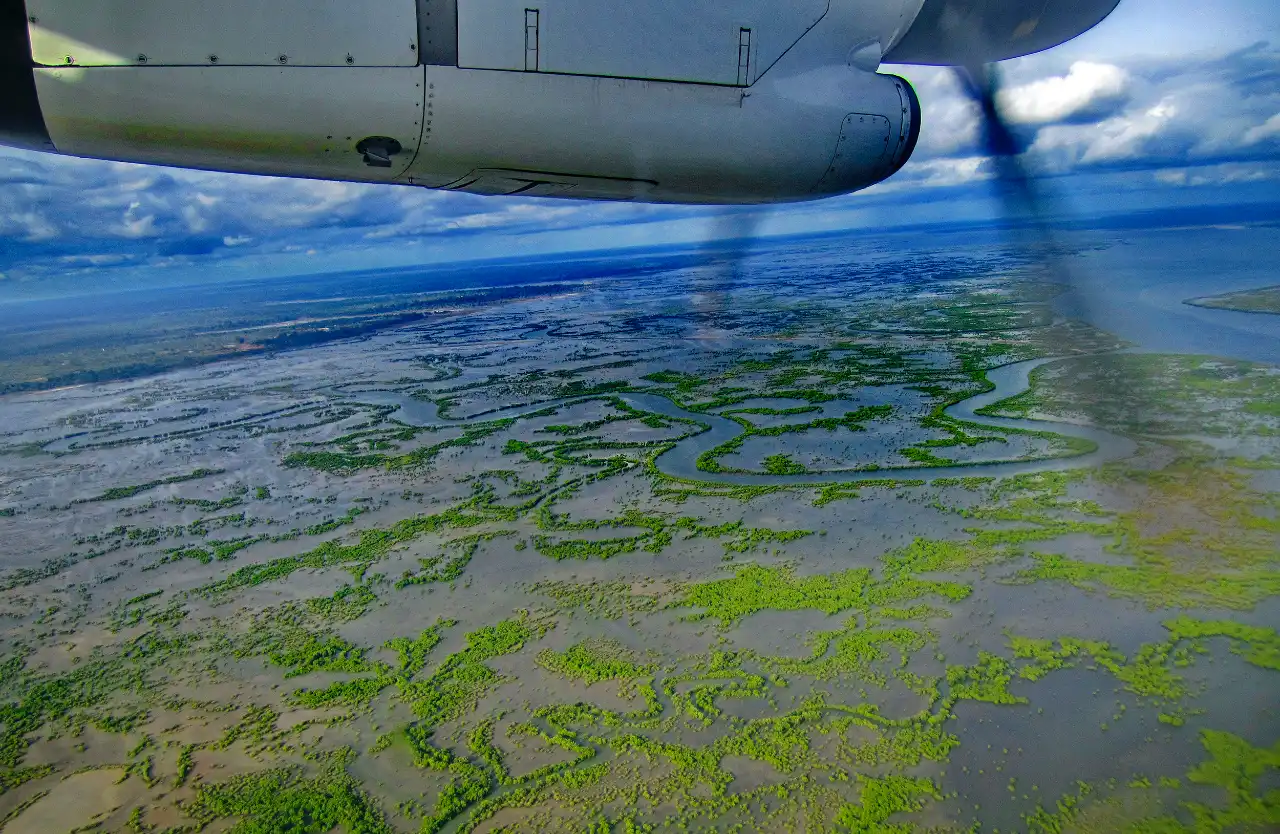
Seen from the sky, Casamance reveals its most majestic face: an emerald maze where the winding bolongs tenderly embrace the mangrove, forming a natural tableau of breathtaking beauty.
Photos: Le Papayer Ecolodge — all rights reserved.
It is always summed up the same way, in the same hurried phrase: « Senegal's green breadbasket », « the country's most fertile region ». These formulas aren't wrong; they're simply lazy. They describe the map, never the territory. Because what unfolds here has nothing to do with crop yields or a brochure's colour palette: it is another way of inhabiting the world — slower, denser, threaded with memory and mystery. Casamance is not visited like ticking off a stop. It is earned, a little — the time to travel up a river, to forget a border, to let your gaze be ruffled.
Beyond the suggested stops, this guide is an honest attempt to say why, at the end of a tour of Senegal, so many travellers leave confiding the same thing: that their most beautiful memory — the most intense, the truest — they found all the way down south.
Your first steps
What to discover in Casamance? Eleven stops at the rhythm of the South
An island, a village, a market or an encounter: choose the stops that speak to you. These eleven destinations in Lower Casamance offer different ways into the landscapes and cultures of southern Senegal.
History · Island
Carabane, following the river’s rhythm
At the river mouth, sandy paths and traces of the former trading post reveal another chapter of Senegal’s history. Choose this island if you enjoy walking, observing and letting your surroundings set the pace.
A tip for your visit Leave time to wander after the pirogue crossing.
Here the river becomes a lookout: visitors watch for manatees and discover the landscape from the great kapok tree. A rewarding stop if wildlife and wide-open views are what draw you outdoors.
A tip for your visit Bring binoculars and patience: wildlife sightings are never guaranteed.
Oussouye sheds light on sacred authority in some Diola communities. Come to explore the connections between spirituality, solidarity and village life, and to understand the people behind the landscapes.
A tip for your visit Discuss your questions with a local guide; an audience depends on permission and availability.
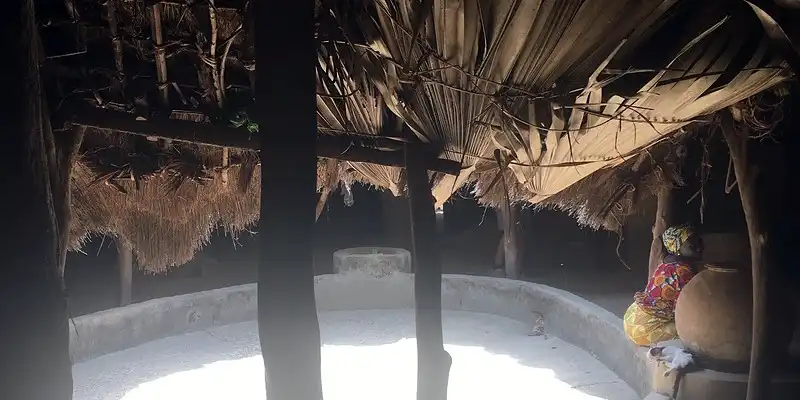
The impluvium house tells a story of communal living, with rainwater collection at its heart. An intriguing stop for anyone interested in architecture, local materials and knowledge passed between generations.
A tip for your visit Ask how the house works: its design becomes much more meaningful.
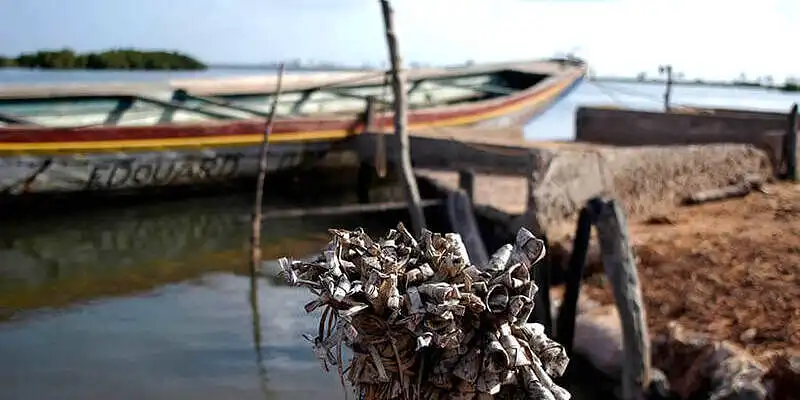
Arriving in Niomoune by water reveals what connects island villages: tidal channels, pirogues and fishing. Choose this journey if the crossing matters to you as much as the destination.
A tip for your visit Plan the crossing with a local boatman, taking the tides into account.
Markets, quays and the Joola Memorial reveal Casamance’s urban character and its history. A stop for travellers who want to combine everyday encounters with an understanding of the region’s collective memory.
A tip for your visit Mix walks with visits, and ask permission before photographing people.
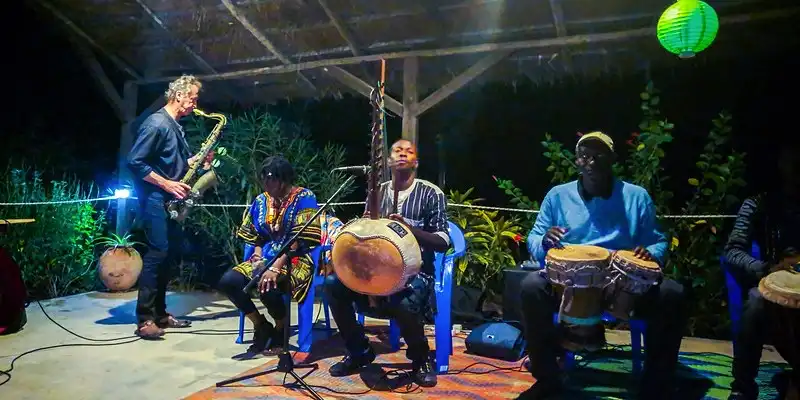
The craft market, the village market and the fishing camp on the beach: the day moves between stalls, pirogues and a seaside lunch, then ends with dinner and live music. A stop for anyone who wants to feel everyday life in Cap Skirring.
A tip for your visit Visit the fishing camp around 11 a.m., when the pirogues usually come in, depending on the sea.
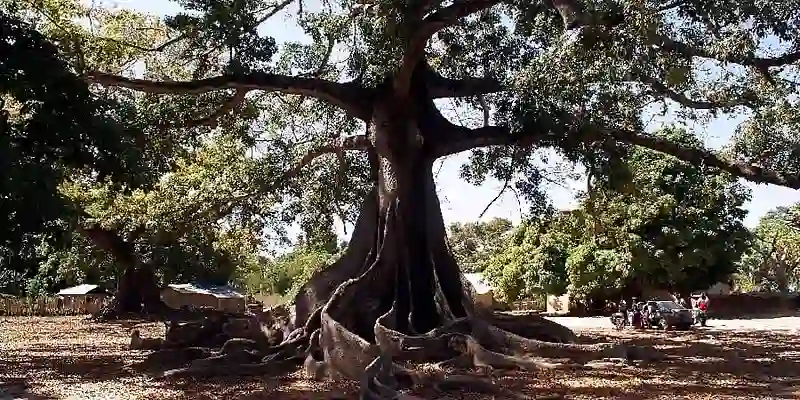
A primary-forest ecopark, the village square with its giant kapok tree, the solar village of Bouyouye and the Sangawatt ecomuseum: a half-day on foot, without a pirogue, in an inland village.
A tip for your visit Start with the ecopark, in the cool of the morning, before the sun gets strong.
A 4x4 to Ziguinchor, then a pirogue through the bolongs to Affiniam: birdlife, fishing and lunch in the great impluvium house. A full day for those who love the water as much as the road.
A tip for your visit Let us know a few days ahead so lunch can be prepared, and bring binoculars for the bird island.
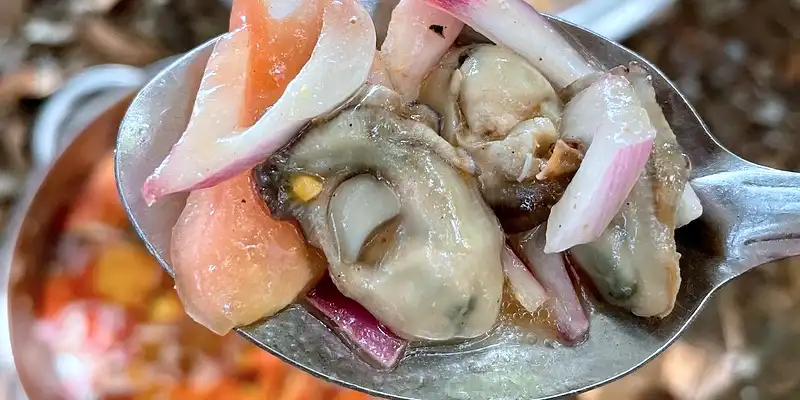
At the end of a track, you board a pirogue on a wild bolong, fish, then picnic by the water: grilled mangrove oysters, fish and bounouk, the local palm wine. A confidential day that almost nobody offers.
A tip for your visit Bring your passport (a photocopy is not enough): Boudédiète, the boarding point, is at the border.
You take a pirogue down the Boudédiète bolong to its mouth, then picnic on a wild Guinea-Bissau beach: oysters, spiny lobsters, crabs and fish grilled over a wood fire, depending on the day’s catch. A confidential day for lovers of open horizons.
A tip for your visit Bring your passport and sun protection: the beach has no shade and no shops, and the sea can be rough at the river mouth.
Once you have chosen your stops, the simplest way is to organise your stay from our base in Cap Skirring: accommodation, excursion rhythm, downtime and local advice.
To plan outings from Le Papayer Ecolodge, explore the excursion programmes and transport options. To understand the landscapes and cultures along the way, continue with this guide.
Look at a map. The Gambia River, with its tiny corridor-country, slices Senegal in two and sets Casamance apart like a whispered confidence. Landlocked between the Gambia to the north and Guinea-Bissau to the south, the region long lived away from the roads and the spotlight. This isolation, once its misfortune, is today its privilege: it kept mass tourism at bay and left nature intact where, elsewhere, it has been smoothed over to please.
Here, the Atlantic doesn't stop at the shore: it pushes nearly three hundred kilometres inland, climbing the bed of the Casamance River and branching into a maze of bolongs, those brackish channels lined with mangroves. The mangrove — Rhizophora on its stilt roots, Avicennia bristling with pneumatophores — is not scenery. It is an organ. It holds the coastline, filters the water, stores one of the most efficient « blue carbons » on the planet, and serves as an irreplaceable nursery for fish, shrimp and oysters.
An amphibious land, where you can no longer quite tell where the land ends and the sea begins.
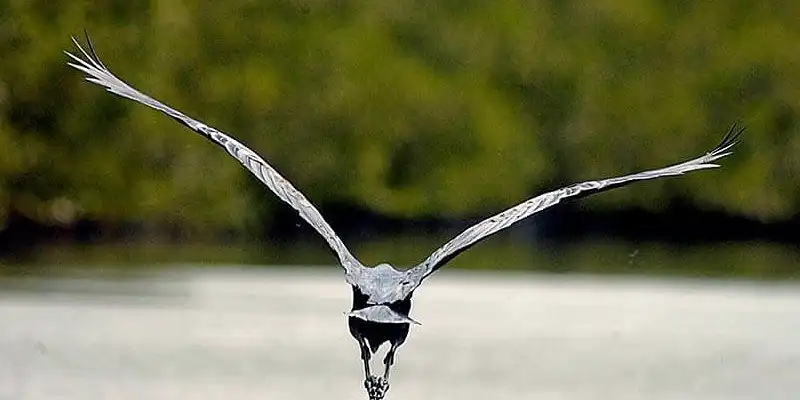
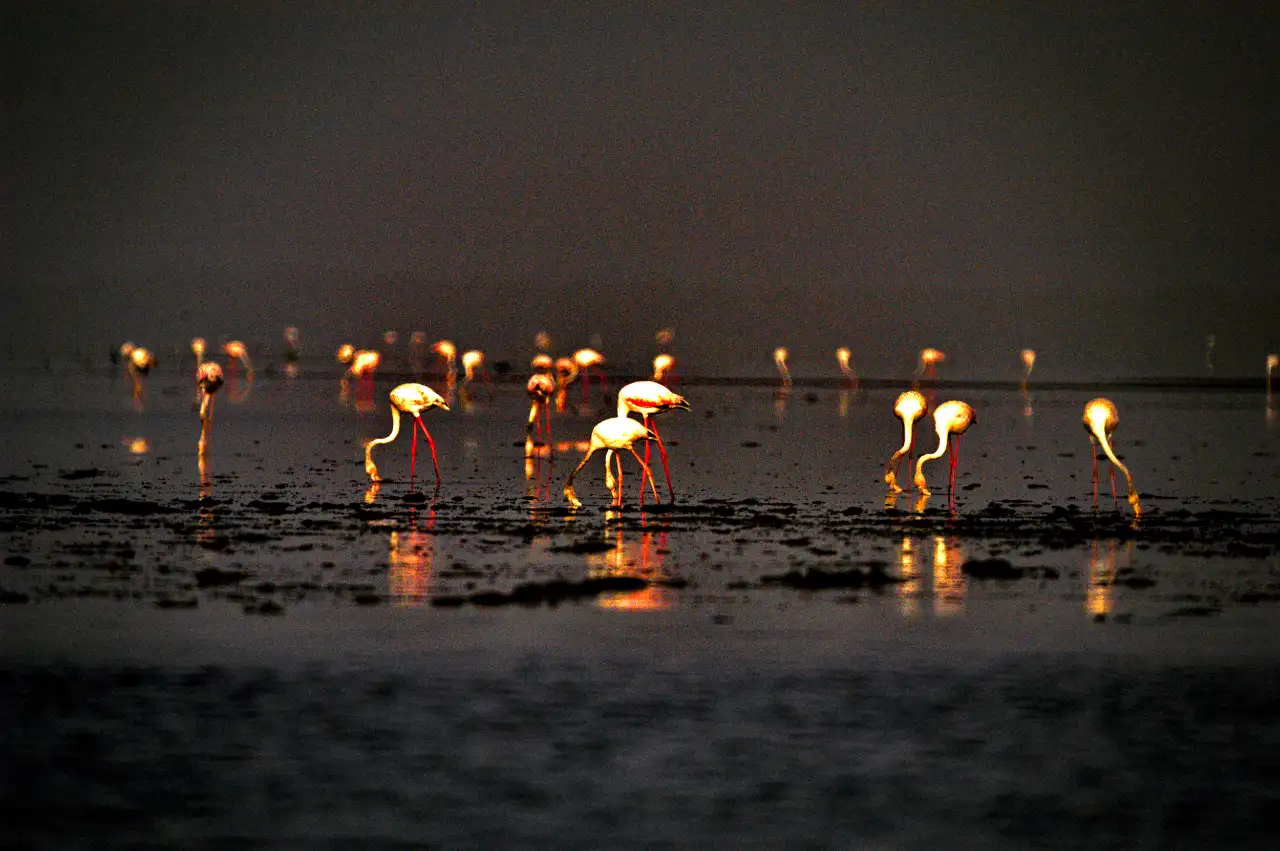
As dusk sets the mudflats of the bolongs ablaze, Casamance reveals its living sanctuary. Regarded as one of West Africa's great birdwatching havens, the region offers an unforgettable aerial ballet every evening.
This rare meeting — ocean, river, dense forest and salt mangrove — makes Lower Casamance one of West Africa's great bird sanctuaries. Several hundred species cross paths here: resident African birds and millions of migrants that come from Europe to winter, from October to April.
In the bolongs reigns the African fish eagle, whose nostalgic cry is inseparable from the landscape; on the sandbanks gather royal terns, grey-headed gulls and flamingos; and inland, in the forests of kapok trees and palms, the green turaco reveals the bright red of its wings only in flight. None of this was arranged for you. It is simply there, and it long precedes you.
Further inland, the Casamance forest holds the densest ecosystems in the country: giants such as the kapok tree (Ceiba pentandra), which sometimes tops fifty metres and from which dugout canoes were once carved; Senegal mahogany, and vène — precious woods now threatened by trafficking. Far from the Sahelian landscapes of the north, an altogether different Senegal unfolds: Sudano-Guinean, well-watered, lush. A genuine green lung, the opposite of the Sahel.
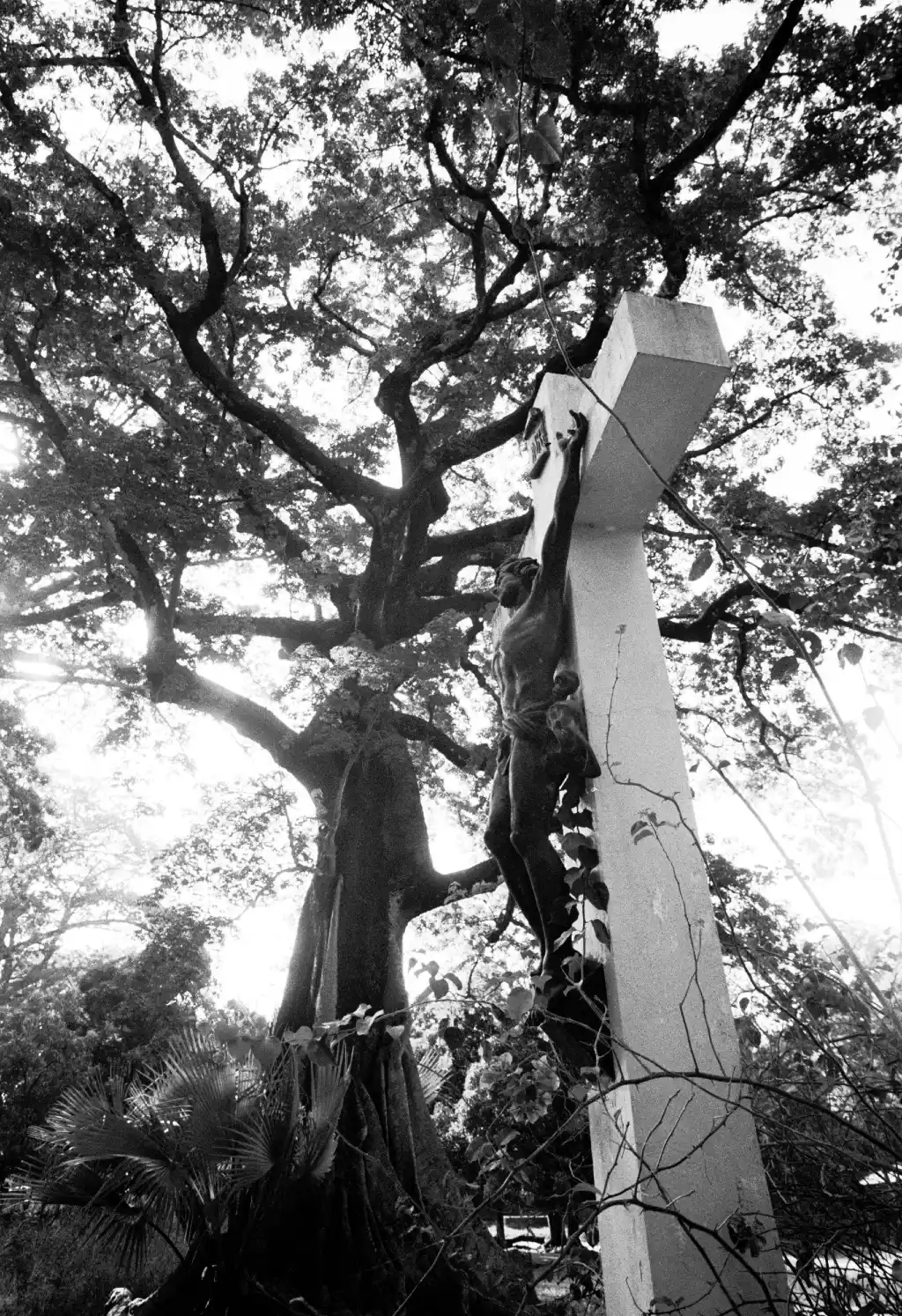
Hidden in the lush primary forest of Afiniam, a majestic sacred kapok tree bears a Christian cross — a striking, poetic symbol of the peaceful syncretism that animates this Casamance village.
A mosaic of peoples
Casamance is a patchwork of peoples: Diola, Serer, Fula, Mandinka, Baïnouk, Karoninka, Balanta, Manjak, Mankanya, Wolof… each with its own language, rites and beliefs. Nowhere else in Senegal is this human density so vivid — nor this singular way of holding the visible and the invisible together.
Ziguinchor, the vibrant capital of Casamance, pulses to the rhythm of a youth bursting with energy and ambition. It is here, in this forward-looking drive, that the true face of the South reveals itself.
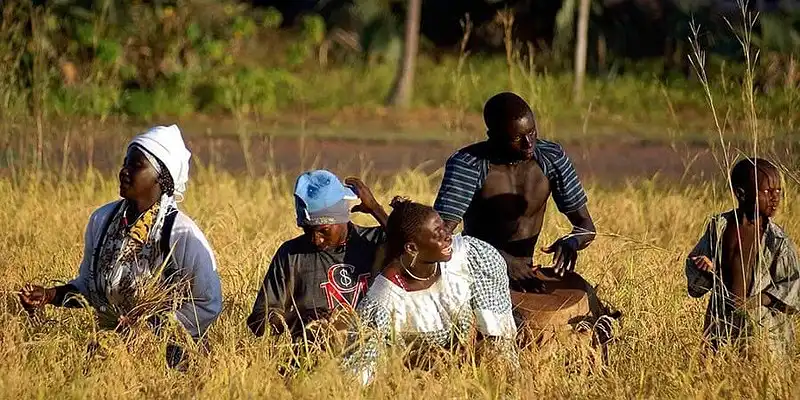
The Diola, the overwhelming majority in Lower Casamance, are its bedrock. Hunter-gatherers in the distant past, they became above all remarkable rice farmers: mastering rice cultivation in mangrove country, raising dikes that push back the salt and hold the fresh water, turning the heavy clay with the kadiandou — that long iron-bladed spade — to form perfect ridges. That is the heart of their identity.
Diola societies have varied forms of organisation: in many communities, collective life draws on elders and ritual leaders; in the kingdom of Oussouye, a sacred king holds religious and customary authority. This diversity goes hand in hand with a strong tradition of village solidarity. Rice remains at the heart of Diola culture. Rice that, traditionally, is not sold: a gift of the spirits, kept in family granaries for the household and for ceremonies, to trade it would be to profane it. Here, quietly, lies another relationship to the world — an economy where some things circulate, are given, are shared, but are never counted.
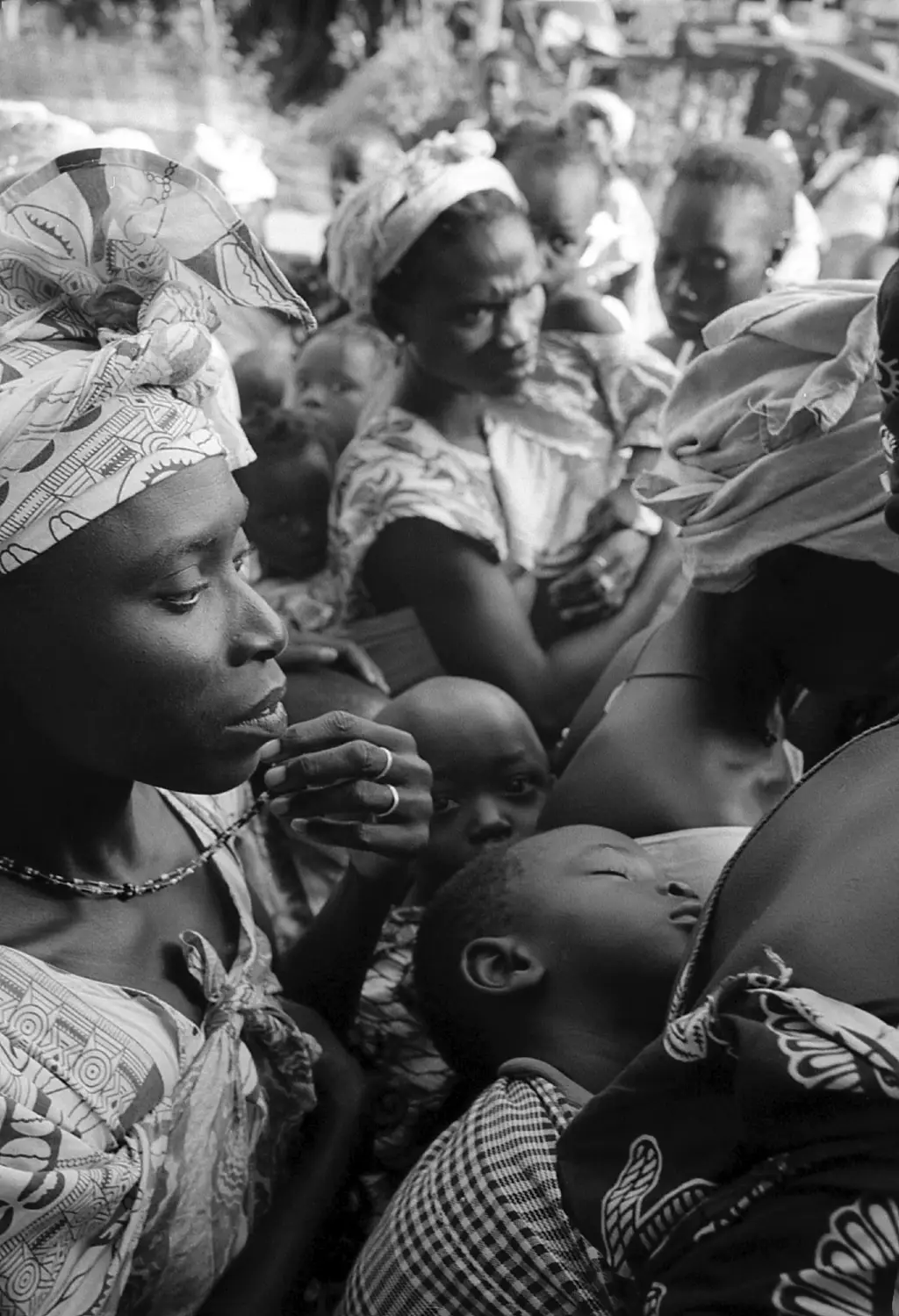
This vitality is written on people's faces. In the streets of Ziguinchor, the capital, youth overflows — laughing, inventive, brimming with energy. This is perhaps the South's first lesson: that such life cannot be reduced to statistics. An immense youth, a relationship to life, death and community untouched by cynicism — the Africa so often spoken of badly elsewhere has, here, a face that laughs and stands tall.
The land where the invisible has its place
In Casamance, the forest is not merely a resource: it is inhabited. Among the Diola, certain woods are sacred — you enter them only after precise rites, and the spirits that dwell there underpin the spiritual and social order of the villages. The women's sacred wood is its pillar, forbidden to men and to the uninitiated, keeper of the initiation rites passed from mother to daughter. To destroy these forests is not only to lose rare species: it is to erase the very culture of the peoples who live there.
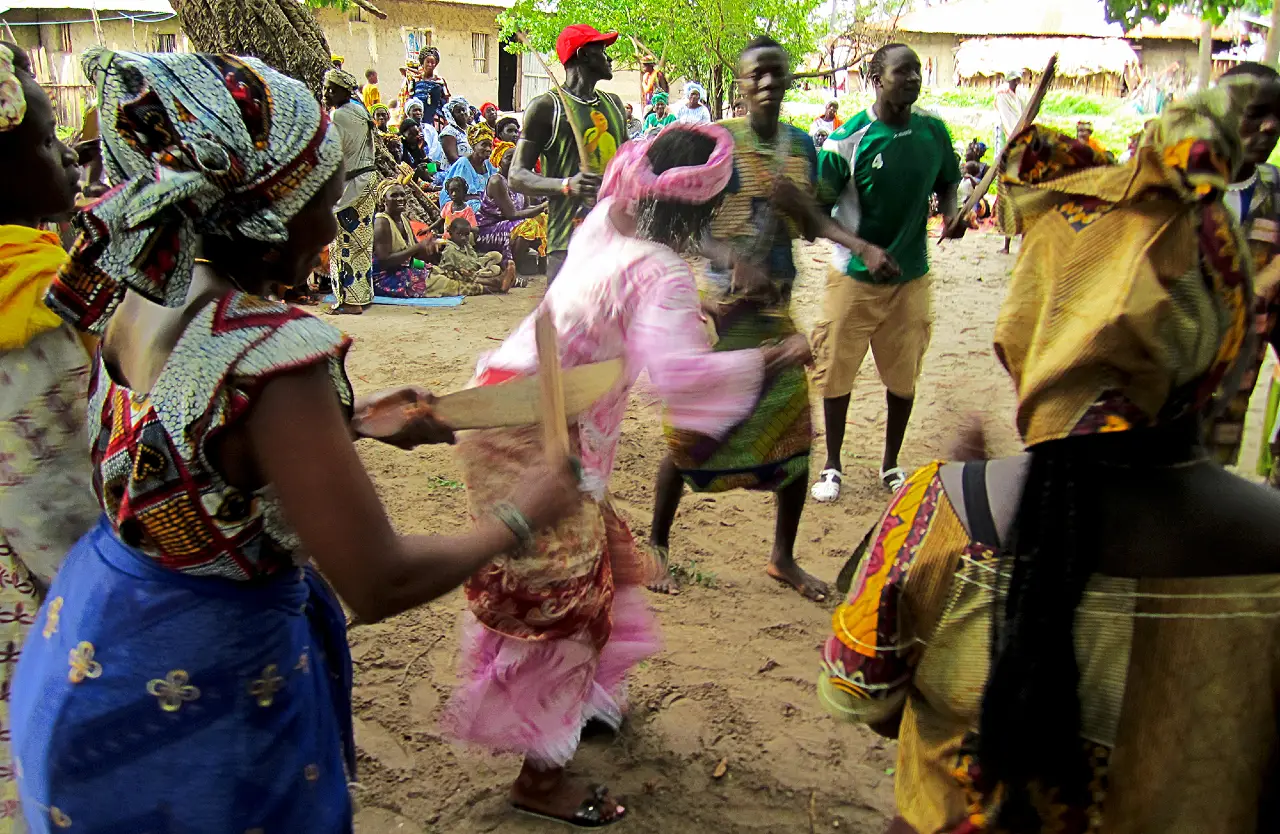
In the heart of the preserved Karone archipelago, the village of Illol awakens to the visceral rhythm of the initiation festivals. Carried by the raw energy of traditional dances, these celebrations offer the traveller a rare immersion in the secret soul of Casamance.
🎧 Listen to the atmosphere: a traditional ceremony in Casamance
From this imaginary world rise figures you never forget. The Kumpo, a mystical creature wrapped from head to toe in palm leaves, a stick planted on its head, whirling to the beat of the drums: for the Diola, this is not a man in disguise but a spirit come out of the sacred wood. For here two worlds must be told apart. Diola culture, the most secret, jealously guards its rites: what happens in the sacred wood is not told, and never will be. Mandinka culture, on the other hand, has brought one of its most spectacular figures into the open — at the risk of seeing it slowly go astray: the Kankourang.
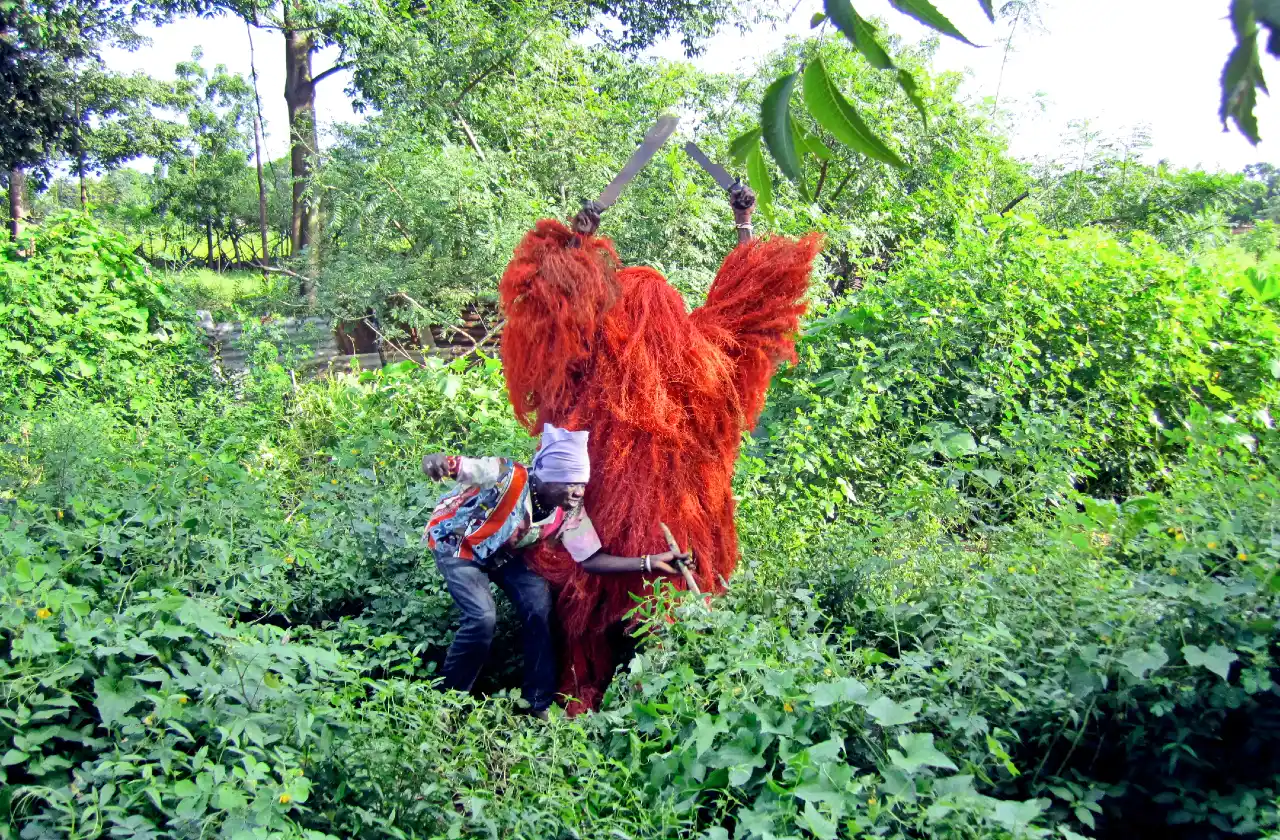
Inscribed in 2005 by UNESCO as intangible cultural heritage of humanity, the Kankourang is a figure covered in dark-red bark fibres, at once protective and feared, who watches over the newly circumcised before their initiation and keeps social order. But the one you meet today in the streets, machete in hand and Nike trainers on his feet, is no more than the folkloric shadow of a far mightier ancestor — the one he is only the modern caricature of, and who bears another name: the Fanbondy.
In the initiation tales, he is said to have been born in the flames to drive out the invader — leaping from tree to tree, all his limbs folded backwards, covering kilometres in a single breath.
The Fanbondy comes from the south, from Guinea-Bissau — the country that fought against Portugal one of the harshest wars of independence on the continent. Legend has it that he was born in the very fire of that struggle, a protective spirit risen to drive out the invader; that he moves with all his limbs folded backwards, leaping from tree to tree and from village to village, now tiny, now several metres tall. The elders would call on him to halt an epidemic, ward off the evil eye, protect the harvests. Of that power, the town Kankourang has kept only the costume. Here, historical fact, the memory of the elders and legend are woven together so tightly you cannot always tell them apart — and that is part of the mystery of Casamance.
Once a year, at the end of the rainy season, over four Sundays, comes the great Djambadon: the Kankourangs take over the towns in a flood of celebration and din. The town freezes to the rasp of machete blades sharpened against the tarmac. Then the festival subsides and they return to the sacred woods — while the old one, the true one, the one who never shows himself, stays hidden where no camera will ever reach him.
To the frenzied rhythm of the great Djambadong, the streets of Ziguinchor catch fire. The mystical appearance of the Kankourangs, protective spirits clad in russet bark, offers a striking plunge into the heart of Casamance's sacred rites. The magnetism of the scene also owes much to one powerful detail: the Jaffoe. The Kankourang always keeps a piece of this sacred fibre in his mouth, chewing it nervously — a sign of his absolute silence, his extreme concentration and the depth of his mystical trance.
The forgotten war, or why the South stayed wild
You cannot understand Casamance while passing over its darker side. This land has always resisted authority imposed from elsewhere. The Portuguese, then the French colonisers, met fierce opposition here. In the early twentieth century came the figure of Djignabo Bassène; during the Second World War, a young Diola queen, Aline Sitoé Diatta, called for a boycott of groundnut farming and of the colonial tax. Deported to Timbuktu, she died there at twenty-four. She is today one of the great heroines of Senegalese memory — the face of a dignity that does not bend.
From this history of resistance was later born a long conflict — one of the oldest and most discreet on the continent, which came to be called « the forgotten war ». We will not recount it here, still less pass judgment: this is neither the place nor our role. What matters is its melancholy, its human cost, and a paradox that changed everything for the region. While tourism fled north to the Petite Côte, Casamance stayed apart — and so, preserved. Where other coastlines filled with holiday homes, its bolongs, its forests and its villages kept their soul.
Today, peace has returned, patiently. The region can be visited with peace of mind; its people ask only to be met. And the traveller who takes the trouble to head south discovers what the rest of the country traded elsewhere for comfort: an authenticity that cannot be manufactured, and that three decades of silence have, despite themselves, kept safe.
Le Joola, the wound the whole country carries
You cannot tell the story of Casamance without naming Le Joola. On 26 September 2002, the ferry linking Dakar to Ziguinchor — the cord between the capital and the South — capsized off the coast of the Gambia, overloaded. At least 1,863 people lost their lives: more than the Titanic. One of the deadliest civilian maritime disasters ever recorded.
There is not one Casamance family this loss did not touch. In a single night, the South lost part of its youth, its students, its lifeblood. Years later, the pain remains intact and the memory alive.
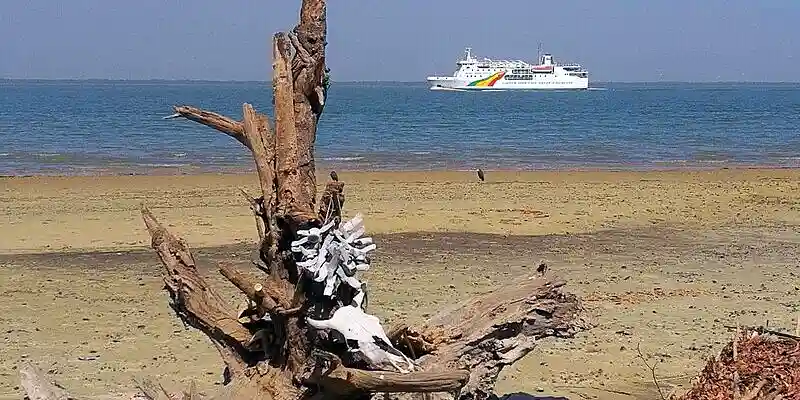
If the ferry that serves Casamance today bears the name Aline Sitoé Diatta, it is no accident: it took a name of dignity and resistance to restore the link the sea had broken. To reach the South, to board this ferry or fly over this river, is also, in its way, to honour that memory — and to recall that Casamance, despite everything, always rises again.
The economy of the living: nature and people, inseparable
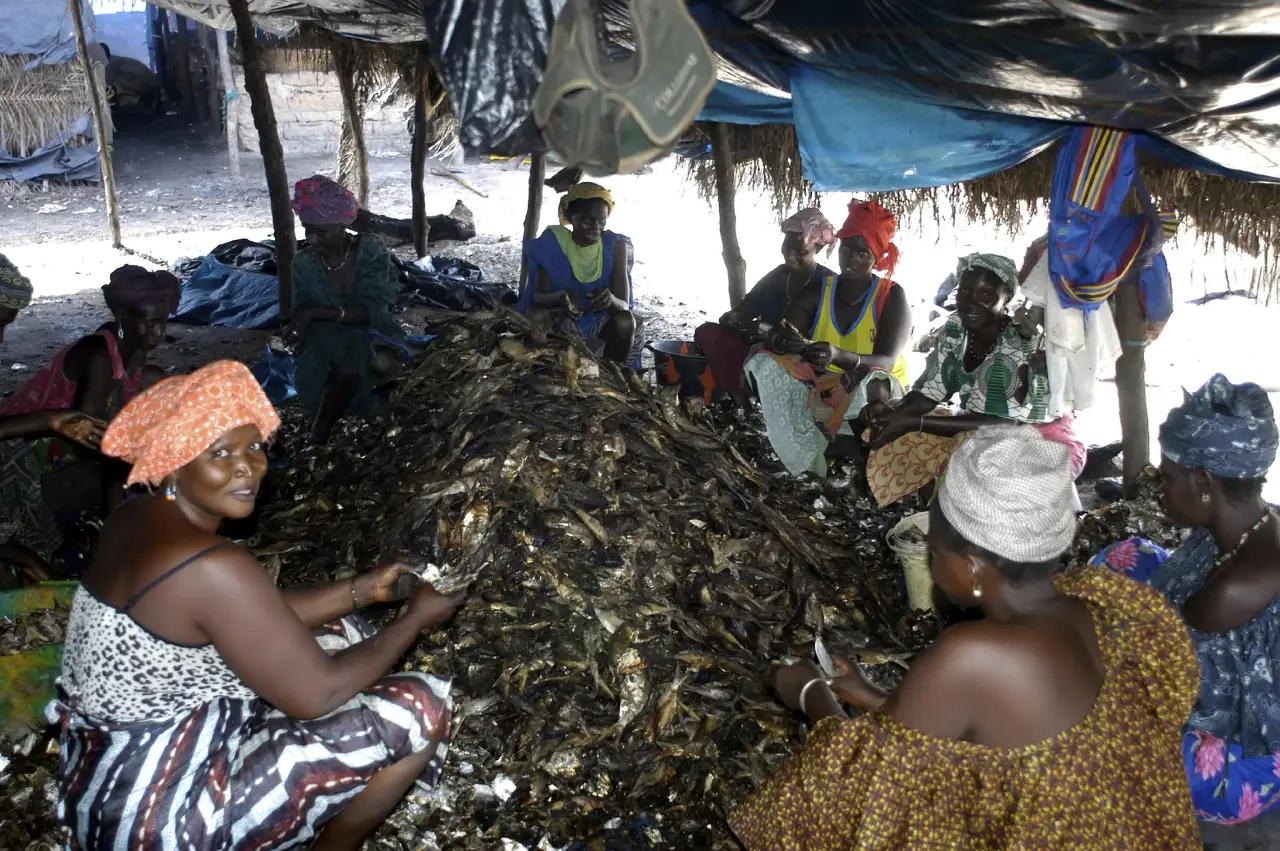
Here, ecology is not a matter of conscience: it is the condition of survival. The river feeds people. Fishing is not just an activity — it is the foundation of food security. On the bolongs, the Diola still casts the cast net, that circular net thrown with a precise flick from a dugout. In the larger hubs like Cap Skirring or Kafountine, it is above all the women who rule the trade: with no cold chain, they smoke, dry and ferment the fish — kéthiakh, gejj — and feed the whole sub-region for months on end. An invisible, essential economy, reinvested in children's schooling and the health of the home.
In the bustle of the Kafountine fishing camp in Casamance, the women processors carry on an ancestral craft, smoking and drying fish in a ceaseless ballet of colour and sea scents.
But this eldorado is showing signs of exhaustion: falling yields, mangrove eaten away by cutting and salt, forests coveted by traffickers. In response, a patient, local resistance is taking shape: marine protected areas where fish breed in safety before « spilling over » into the fishing grounds, community reforestation where mangrove propagules are replanted at low tide, village committees turned guardians of the forest. Here, the living has regained its value — more than processed timber or fish sold off cheap. It is a lesson in ecology you will find in no book: that of people whose very lives depend on the health of the river.
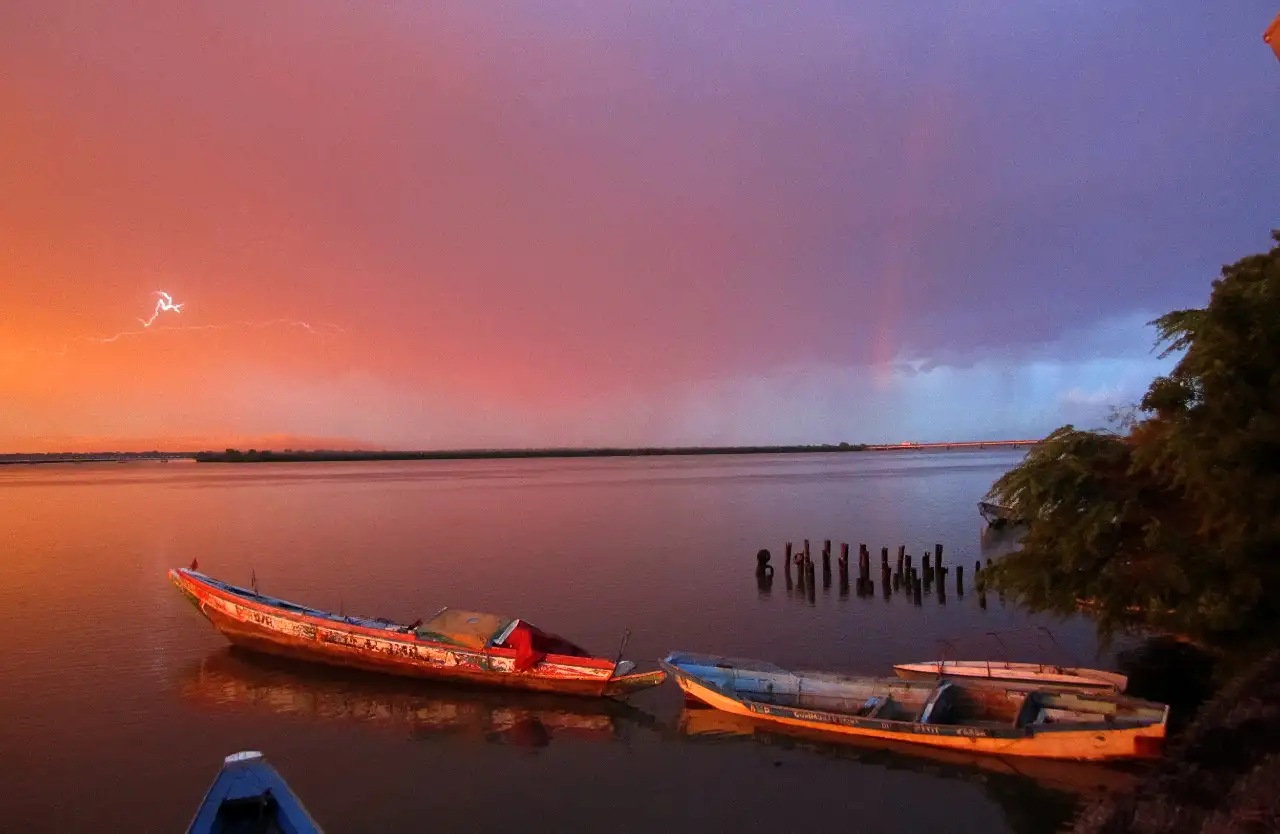
The rainy season in Casamance is an unforgettable visual symphony. In a sky tormented by the rains, light triumphs with raw beauty, offering the magical spectacle of vivid rainbows mingling majestically with lightning.
🌿 The Living Calendar of Casamance
Nature's clock and the biodiversity of Casamance
Indicative markers, based on local observation and the knowledge of the inhabitants — nature, for its part, always keeps its share of the unexpected.
November – January
Rice harvests (Oryza glaberrima / Emon) and harvest festivals. Arrival of the migrants: pelicans (Pelecanus onocrotalus / Ekanji), flamingos (Phoenicopterus roseus), storks (Ciconia ciconia) and wild ducks (Anas querquedula / Ebak). Tasting of wild fruits: ditakh (Detarium senegalense / Kabitak) and baobab fruit (Adansonia digitata / Buki). Intensive artisanal fishing of bonga shad (Ethmalosa fimbriata / Eman) for drying and smoking, along with threadfin (Polydactylus quadrifilis / Ekenge) and white grouper (Epinephelus aeneus / Eseky). In the bolongs (Ebak), sightings of the manatee (Trichechus senegalensis / Esnil) and the pied kingfisher (Ceryle rudis / Ejak), and harvesting of mangrove oysters (Crassostrea gasar / Efeek).
February – April
Harvest under the cashew trees (Anacardium occidentale / Kankara) for nuts and cashew apples, tasting of velvet tamarind (Dialium guineense / Esel), ripening of rônier palm fruit (Borassus aethiopum / Ebe) and cutting of oil-palm bunches (Elaeis guineensis / Eten) for red palm oil. At low tide, the ballet of fiddler crabs (Uca tangeri / Ekalal) and mudskippers (Periophthalmus barbarus / Ekuya) under the gaze of sacred ibises (Threskiornis aethiopicus) and African spoonbills (Platalea alba), while Nile monitors (Varanus niloticus / Eko) and crocodiles (Crocodylus suchus / Enyak) bask on the banks. Red-billed firefinches (Lagonosticta senegala / Esenjen) and the African hoopoe (Upupa africana) liven up the gardens. In the bolongs and the estuary, it is peak season for mangrove shrimp (Penaeus notialis / Ejip) and the small black tilapia / wass (Sarotherodon melanotheron / Eñil) used for the true caldou, alongside mullet (Mugilidae / Emuy), grunts (Pomadasys jubelini / Ekin), sardinella or yaboy (Sardinella aurita / maderensis / Esewe), crevalle jack (Caranx hippos / Echaw), red snapper (Lutjanus agennes / Ekanj) and Senegal croaker (Pseudotolithus senegalensis / Esewe), mingling with Atlantic humpback dolphins (Sousa teuszii / Enyas).
May – June
Peak mango season (Mangifera indica / Manga), gathering of wild madd (Saba senegalensis / Kuguissai), tasting of fresh palm wine (Bounouk) and appearances of the ritual mask Kumpo. Spectacular flowering of flame trees (Delonix regia), baobabs (Adansonia digitata / Buki) and the majestic kapok trees (Ceiba pentandra / Hupun). The song of the barbary shrike (Laniarius barbarus), the flight of red-billed hornbills (Tockus erythrorhynchus / Echich), the call of the fish eagle (Haliaeetus vocifer / Ekouk), the Abyssinian roller (Coracias abyssinicus) and green monkeys (Chlorocebus sabaeus / Ekee) animate the canopy while the rice is worked with the Kayendo. Awakening of the reptiles: green mamba (Dendroaspis viridis / Elor) and pythons (Python sebae / Erim).
July – October
The rainy season (Wanaye) turns the region into a lush forest. Working the land sets the rhythm of the days: ploughing, transplanting and the growth of rice weave an emerald carpet, alongside maize and groundnut (Arachis hypogaea). In the foliage, weavers (Ploceidae) bustle as they braid their hanging nests, while the downpours send termites into flight and bring clouds of colourful butterflies (Lepidoptera). The undergrowth teems with wild mushrooms. In September, tradition resounds with the spectacular outings of the protective mask Kankourang. Wildlife is in full swing: reptiles emerge, such as the black-necked spitting cobra (Naja nigricollis / Elor) and the puff adder (Bitis arietans). At night, sea turtles (Chelonia mydas / Ekasi) come to lay their eggs on the beaches and a ballet of fireflies (Lampyridae) lights up the vegetation to the thunderous chorus of amphibians (Anura / Echuu).
A philosophy of less, born on the spot
You think you're coming to an « eco-lodge », and you leave with a question. Because living this close to nature quickly teaches a humility no dashboard can measure. You can dig your well, raise your solar panels, chase every watt — and soon believe yourself « 100% self-sufficient ». It's a lovely illusion. You always depend on something: on the sun and wind that do as they please, on the rain, on the sea that slowly takes back everything you leave it. Perfect self-sufficiency doesn't exist. Well-managed interdependence does — and that is already a great deal.
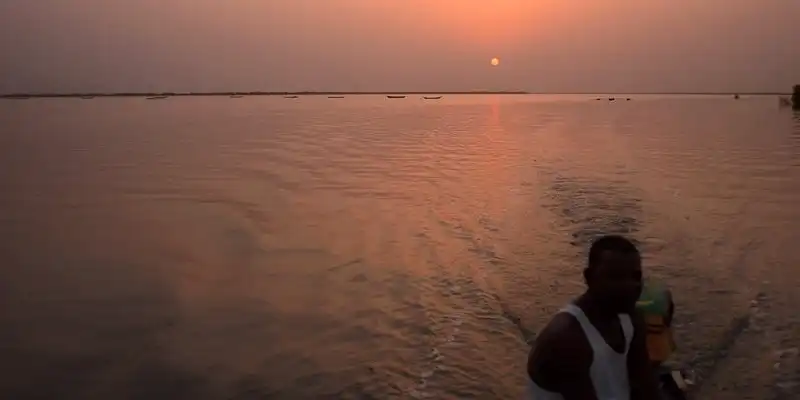
Under a light breeze, the ripples of the Casamance River turn to gold, gently carrying a myriad grains of pollen escaped from the mangrove. A true poetry of the infinitely small.
The role of a place like this is not to display a score, nor to judge. It is humbler: to make visible, for the length of a stay, what we consume without seeing. A light you switch off on your way out. Water that rises by the sole force of gravity. Electricity that sleeps when the sun goes down. Not to induce guilt — to open the eyes.
And because here, in this mystical land, the invisible holds its full and rightful place, the most rational setup only holds if you also respect what cannot be calculated: nature, matter, people and their beliefs. You do not tame a nature like this. You learn to live with it.
« I know. But I'm doing my part. » — the bird of the legend, carrying its drop of water to the fire.
There is an old story they tell here. Faced with the fire ravaging the bush, a little bird shuttles back and forth tirelessly to throw onto the flames the few drops its beak can hold. The other animals watch, incredulous: « You're mad, you'll never put out the fire. » And it replies: « I know. But I'm doing my part. » To head down to Casamance is, in the end, perhaps just that: to agree to do your part, and to discover that a place greater than yourself still has the power to change you.
The everyday heroes: the pride and soul of the South
One morning at the old ferry landing, the gathering point of the canoe men, is enough to understand what the Casamance soul is made of. The town is barely waking, bathed in a bluish mist hovering over the river. On stall-fronts cut from old oil drums, the kinkeliba is warming. The tapalapa, that dense bread of almost mythical virtues, has just been delivered. It is a rare commodity, the exclusive property of the early-rising fishermen and the regulars who put the world to rights with Seydou over a glass of tea. In the background, the crackling voice of RFI spits out the news of a distant world, while canoes laden with oranges and tangerines from the islands are unloaded.
Sitting there, facing the river, you observe a humanity of rare density. Life here offers fewer safety nets than elsewhere: the margins are thin, and no one romanticises it. That is what makes all the more striking the solidarity, the inventiveness and the tenacity you meet at every street corner — not because scarcity would be a virtue, but because here these qualities are not optional.
Here, every day, you meet a resourcefulness that commands admiration: teaching yourself by rigging a connection with two copper wires, healing with the plants of the forest, watching over the most vulnerable where no public safety net exists. None of this prettifies the hardship — it is very real. But you cannot help being struck by what keeps people standing: the dignity that holds them up, a quiet pride, the refusal to bow to fate.
The day of Eid al-Fitr in Ziguinchor, Casamance, when the alms marking the end of the Ramadan fast are given. This obligatory alms, paid by those who can afford it to feed the needy, lets everyone celebrate the festival in dignity.
These men and women can withstand anything without giving up. Unrankable by the yardsticks of Western success, they embody a notion of hope that, in Casamance, takes on its full meaning. This hope is not the passive wait for providential aid, but an unshakeable life force, a silent certainty of their own worth. It is also to meet their gaze, to touch that serene pride and relearn what it truly means to stand tall, that one comes to drop anchor in the South.
And us — how do they see us? There is a Wolof expression the traveller always ends up hearing, half-teasing, half-tender: Toubab dougnou nit. Literally, « the Toubab — the white person — is not a human ». Nothing hostile, quite the opposite: it describes someone who seems to come from a world without want or weariness, almost otherworldly, spared the ordinary trials. But in a language where « nit », the human being, is thought of first through bonds — hospitality, mutual aid, the given word — the phrase quietly holds up a mirror too. And you come to understand, little by little, that the real journey may be to relearn that kind of humanity: the kind that cannot be measured, and that is woven.
Map of our Casamance excursions
Le Papayer Ecolodge is your base camp: from here all the excursions fan out — to the islands, the bolongs, the Diola villages and the markets. Tap a point to explore it.
The excursion destinations, around Le Papayer Ecolodge (yellow point).
North or South Senegal: why go all the way down to Casamance?
Most travellers discover the north of Senegal first: Dakar and Gorée Island, the Pink Lake, Saint-Louis and its colonial architecture, the Petite Côte around Saly, the lagoons of the Sine Saloum. Beautiful stops, easy to reach from the capital. But many of our guests admit, once they arrive at Le Papayer Ecolodge, that they had worked their way through the northern lodges without daring to cross the Gambia River… and that Casamance turned out to be, by far, the highlight of their trip.
The contrast is striking. Where the north is drier, busier and more beach-focused, the South is green, riverine and alive: endless mangroves, bolongs you glide up by pirogue, sacred forests, Diola villages where the encounter is not staged. Here you change your pace, not just your scenery. It is another Senegal — the one its relative isolation has preserved.
Do you have to choose? Not necessarily. Casamance combines very well with a stay in the north: a domestic flight from Dakar to Cap Skirring links the two in just over an hour. Our advice, if you are hesitating: save Casamance for the end. It is the region you find hardest to leave.
Why visit Casamance, at the very south of Senegal?
Because Casamance is not a « nature » version of the Senegal you already know: it is another country within the country — greener, deeper, more alive. Because its isolation has preserved it. Because you still meet cultures here that have not been staged. And because, very concretely, those who tour Senegal's eco-lodges often say the same thing on the way back: it was down south, right at the bottom, that they lived the best of their trip.
To experience it, you need an anchor point: a place that knows this land from the inside — its guides, its bolongs, its villages. That is the role of Le Papayer Ecolodge, on the seafront at Cap Skirring — the starting point for all these discoveries. From there, you explore:
You probably have to come all the way here to understand the phrase repeated at Le Papayer Ecolodge like a quiet truth: here, there is everything with nothing — and with nothing, there is everything. You arrive with full suitcases and leave lighter — with the unsettling sense that the excess, perhaps, was on our side. Casamance won't give you what you came looking for: it will take away what you never needed. And that is infinitely more.
Estimate your journey to Cap Skirring
Transport
Route
Duration
The experience
✈️ Direct flight (Transavia)
Paris-Orly ➔ Cap Skirring
6 hrs
Non-stop from Paris — the simplest option.
✈️ Domestic flight
Dakar ➔ Cap Skirring / Ziguinchor
45 min
The fastest, from the capital.
🚢 Ferry Aline Sitoé Diatta
Dakar ➔ Ziguinchor
One night
A legendary crossing and a magical arrival on the river.
🚗 Road / Car
Dakar ➔ Cap Skirring (via the Gambia)
7 to 8 hrs
Ideal for road-trip lovers.
🎒 Don't forget to pack for the South
Casamance on film: the sacred wood ceremony
Songs, dances and trance: a traditional Diola ceremony, filmed in the heart of Casamance.
FAQ: planning your trip to Casamance
📍 Where is Casamance? Is it part of Senegal?
Yes, Casamance is an integral part of Senegal: it is the southern region of the country, separated from the north by The Gambia and bordered to the south by Guinea-Bissau. It covers the regions of Ziguinchor, Sédhiou and Kolda. Cap Skirring, home to Le Papayer Ecolodge, lies in the Ziguinchor region on the Atlantic coast.
🌍 Why choose Casamance over another region of Senegal?
Beyond the Gambia River, Casamance reveals a radically different Senegal: a lush landscape of mangroves, great rivers and sacred forests. Unlike the Petite Côte or Dakar, the South offers a slower pace, deep cultural immersion in Diola country and genuinely authentic human encounters. It is the ideal destination for those seeking a grounded, nature-filled and restorative journey.
📅 When is the best time to visit Casamance?
Casamance is best visited during the dry season, from November to May, with sunny days and pleasant temperatures. November and December are especially spectacular: the vegetation is still a brilliant green just after the monsoon. The rainy season (July to October) offers a lush, vibrant natural world, ideal for lovers of wild landscapes.
✈️ How do you get to Le Papayer Ecolodge in Cap Skirring?
Cap Skirring has an international airport served by direct flights from Paris in high season, or via regular domestic flights from Dakar (Ziguinchor or Cap Skirring). You can also arrive by boat from Dakar, taking the ferry to Ziguinchor — a legendary crossing on the river. From Ziguinchor or the airport, a taxi ride takes you straight to Le Papayer Ecolodge on the seafront.
🌱 What is the « philosophy of less » and the off-grid stay at Le Papayer Ecolodge?
Our eco-lodge runs entirely off-grid, powered by solar energy and careful water management. For our guests, this does not mean giving up comfort, but rather relearning the rhythm of nature: living with the arc of the sun, savouring the cool sea breeze and rediscovering the luxury of simplicity. It is the experience of an understated, responsible luxury, rooted in its environment.
🛶 Which excursions are must-dos from the eco-lodge?
From Le Papayer Ecolodge in Cap Skirring, you can explore the bolongs (sea channels) by traditional dugout among the mangroves, visit island villages such as Djilapao or Niomoune, discover Diola traditions and the forests of giant kapok trees, or join a day of artisanal fishing. All our excursions are led by local guides passionate about the region.
🛡️ Is Casamance a safe destination for family or solo travel?
Casamance welcomes families, couples and solo travellers every year. The region is prized for the hospitality of its people (the Teranga) and the peaceful atmosphere of many of its visitor areas. As anywhere in Senegal, it remains wise to follow official travel advice and local recommendations.
🧭 Is Casamance worth the trip?
Yes, without a doubt — it is often the highlight of the journey for those who make the effort to travel south. Casamance offers a greener, more riverine and more authentic Senegal than the north: mangroves, pirogue trips along the bolongs, sacred forests and Diola villages. The Gambia River acts as a natural border, and it is precisely this relative isolation that has kept the region away from mass tourism.
🗓️ How many days should you plan for Casamance?
Allow at least 4 to 5 days to truly experience Casamance, and ideally a week to combine seaside relaxation at Cap Skirring with excursions: pirogue trips through the mangrove, villages, sacred forest and fishing. Many of our guests extend their stay, as the slow pace of the South invites you to slow down. Booking directly with the eco-lodge includes complimentary breakfast.
🔁 Can you combine northern Senegal and Casamance?
Absolutely. A domestic flight links Dakar to Cap Skirring in just over an hour, making it easy to pair the northern highlights — Dakar, Saint-Louis, the Sine Saloum — with a few days in Casamance. Our tip: save the South for the end of your trip, as it is the region you will find hardest to leave.
A word from your host
I have lived in and travelled across Casamance for more than twenty years. Le Papayer Ecolodge was never conceived as a mere hotel, but as a respectful bridge between you, this wild nature and the people of the South. I look forward to welcoming you and sharing our secrets with you.
— Laurent, Le Papayer Ecolodge
They experienced Casamance at Le Papayer Ecolodge
★★★★★
« An authentic paradise, far from all the pressures of modern society. Knowing the eco-lodge is completely self-sufficient in energy and water is a feat in this region. A total immersion in simple living, where recharging truly becomes possible. »
« Laurent took us to discover an animist village and its fetishes, to climb a sacred tree and admire Casamance from 25 m up, to watch manatees and explore the mangrove by dugout. Fabulous memories in a beautiful, restful place. »
« A beautiful, peaceful, flower-filled retreat overlooking a vast beach — reassuring yet wide open to its surroundings. Rewarding excursions, lovely staff, delicious meals… and a genuine ecological project shared with passion. »