Diembéring Excursion: Giant Kapok Tree, Ecopark, Solar Village and Jola Museum
Just 20 minutes by 4x4 from Le Papayer Ecolodge, Diembéring is a small, remote Jola village where people speak kwatay. We start early at the ecopark, then discover the village square and its giant kapok tree, the solar village of Bouyouye, where you can have lunch, and the Sangawatt ecomuseum, devoted to Jola traditions, before a break at the pool of the hôtel Maya.
This page presents the excursion, the village, its kapok tree, the ecopark, the ecomuseum and our practical advice. It is part of our excursions in Casamance; if you are planning a longer stay, our complete guide to Casamance will help you put your stops together.
The excursion at a glance
- Format
- Half-day by 4x4, which can stretch into a full day with lunch and the pool
- Journey
- About 20 minutes by 4x4 from Le Papayer Ecolodge
- Village
- The square of Diembéring and its giant kapok tree
- Nature
- The Casamance Écoparc, 400 hectares of primary forest, best visited early in the morning
- Solar village
- Bouyouye, where you can have lunch on the spot
- Culture
- The Sangawatt ecomuseum, devoted to the traditions of the Awatt Jola
- Relaxing
- On the way back, the pool of the hôtel Maya, with a drink
- Language
- Kwatay, a Jola dialect specific to the village
- Reserved for our guests
- For guests staying at Le Papayer Ecolodge
Like all our excursions in Casamance, this one is reserved for our guests, that is, for people staying at Le Papayer Ecolodge: we do not run excursions for outside visitors. To plan the half-day, request a call back or request your quote online.
The route: from Cap Skirring to Diembéring
You set off from Le Papayer Ecolodge by 4x4: allow about 20 minutes to reach Diembéring, a village of Lower Casamance north of Cap Skirring, set on sand dunes among palm trees and rice fields. First comes the ecopark, early in the morning to avoid the heat, then the village square, the solar village of Bouyouye, where you can have lunch, and the ecomuseum, before heading back to the lodge with a stop at the pool of the hôtel Maya.
For another day among the Jola villages, see our excursion to Affiniam, which combines pirogue, bolongs and an impluvium house.
Indicative map: approximate landmarks, not an exact route.
What you discover on the excursion
A half-day of forest, villages and Jola heritage. Here are the highlights:
- The ecopark A 400-hectare primary forest, to explore early in the morning, on foot or by bike.
- The square and its kapok tree The great tree at the heart of the village, a meeting place.
- Kwatay A Jola dialect you can hear in Diembéring.
- The solar village of Bouyouye A traditional village powered by solar panels, with lunch available on the spot.
- The Sangawatt ecomuseum An open-air museum on the traditions of the Awatt Jola.
- The pool of the hôtel Maya A cooling break on the way back, with a drink.
The Casamance Écoparc, best visited early in the morning
Close to the village, the Casamance Écoparc covers 400 hectares of primary forest. Created in 2010, notably with the support of Ecofund and the Eiffage group, it follows a logic of "rational" management rather than a total ban: local people can gather dead wood, leaves and fruit there, and they take part in reforestation during the rainy season. Agroforestry students and teachers come for field studies, and many tree species have been recorded there.
You explore it with a guide, on foot or by bike, along trails leading to clearings, baobabs, termite mounds and astonishing shell mounds, witnesses to the history of the settlement of the coast. We do it early in the morning, to avoid the beating sun: it is a lovely, cool walk in the forest. To understand what is at stake in these environments, read our feature on protecting biodiversity in Casamance.
Diembéring: a remote Jola village
Diembéring is a Jola village in Lower Casamance, the administrative centre of its rural community, about ten kilometres north of Cap Skirring. It spreads over sand dunes, among palm trees, tall kapok trees, rice fields and the beach. A former fishing village, it still is one, even if tourism has opened up other prospects. There is a mosque and a church, where mass is said in the Jola language.
The village also has its own language: kwatay, a Jola dialect that is hardly spoken anywhere else. It is a detail that says a lot about Diembéring's remoteness and strong identity. As everywhere in Jola country, be respectful: ask permission before photographing local people.
The village square and its giant kapok tree
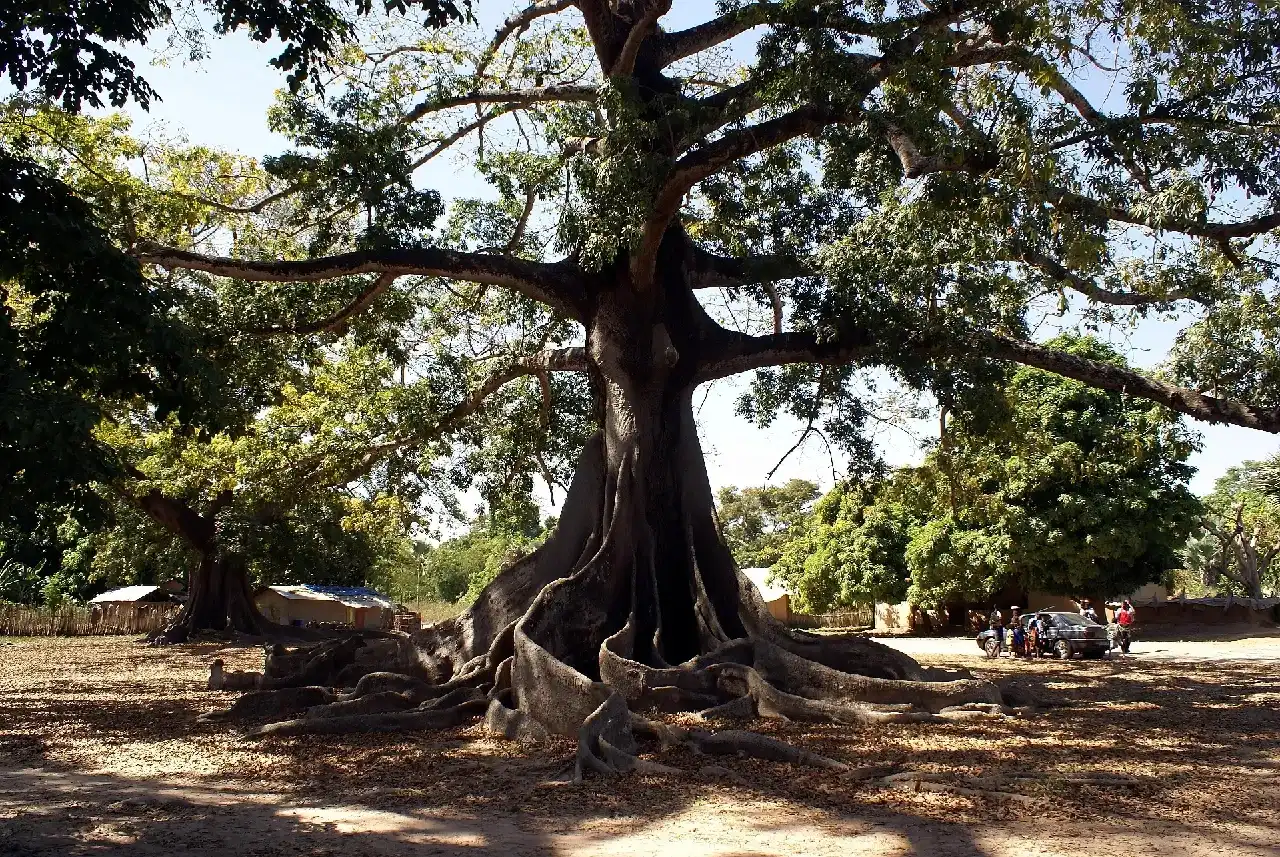
The heart of the village is its square, dominated by a giant kapok tree, the village's sacred tree, with a massive trunk and immense buttress roots. As in many villages of West Africa, the tree is a place for gathering and exchange: people sit in its shade to talk, trade or wait. It is a lovely spot to understand how a Jola village is organised, and to rest in the shade before the rest of the visit.
Another great sacred kapok tree can be visited on our excursion to Affiniam; to learn more about this tree, read our feature on the wood species of Casamance.
Bouyouye, the solar village, and lunch
After the ecopark and the square of Diembéring, we continue to Bouyouye, in the rural community of Diembéring, reached by a laterite track between Cap Skirring and Diembéring. It is known as the "solar village": thanks to its solar panels, the village has electricity 24 hours a day and running water, two rare assets in rural Casamance, while keeping its traditional character.
You discover about fifty houses, baobabs and mango trees, and daily life: the women gather oysters, the men look after the palm wine and the building work. The water pump is even installed at the top of a baobab. It is possible to have lunch on the spot, which makes Bouyouye an ideal midday stop.
The Sangawatt ecomuseum and Jola traditions
Just before the village, the Sangawatt ecomuseum is an open-air museum devoted to certain aspects of the traditional life of the Awatt Jola. The visit is theatrical: the curator guides you and invites you to sing along, starting by greeting the ancestors in front of a fetish hut.
You discover about fifteen plants with therapeutic, spiritual or social virtues (some, for example, are used to ease the pains of childbirth), mystical and ritual objects (pottery, ropes, animal skulls), as well as everyday items: fishing baskets, rice containers, mortars for pounding grain. It is an excellent introduction to Jola culture, before or after the village visit.
A stop at the pool of the hôtel Maya
On the way back, we stop at the hôtel Maya, on Boucotte beach, north of Cap Skirring, to enjoy its pool, with a drink. The hotel is made up of large thatched-roof huts, with a restaurant and a swimming pool: a chance to cool off before heading back to the lodge.
A typical day in Diembéring
Times are only indicative: they adjust to your pace and to the season.
- Early start: from Le Papayer Ecolodge, by 4x4 (about 20 minutes), to avoid the sun.
- Ecopark: a guided walk in the forest, on foot or by bike, in the cool of the morning.
- Village: the square of Diembéring and its giant kapok tree.
- Bouyouye: the solar village, with lunch on the spot if you wish.
- Sangawatt ecomuseum: the theatrical visit on the traditions of the Awatt Jola.
- Return: a stop at the pool of the hôtel Maya, with a drink, then back to the lodge.
Practical advice for your excursion
- Allow a half-day, which becomes a full day if you have lunch at Bouyouye and enjoy the pool: about 20 minutes of travel each way.
- Leave early: the ecopark is much more pleasant in the morning, before the sun gets strong.
- Bring swimwear for the pool of the hôtel Maya.
- Bring a hat, sunscreen, water and comfortable shoes for walking on sand and in the forest.
- Always ask permission before photographing local people.
- In the village and at the ecomuseum, be respectful: these are places of daily life and tradition.
- The dry season, from October to June or so, is the best time for the visit.
Frequently asked questions about the Diembéring excursion
Where is Diembéring?
Diembéring is a Jola village in Lower Casamance, about ten kilometres north of Cap Skirring, roughly 20 minutes by 4x4 from Le Papayer Ecolodge.
How long does the excursion last?
A half-day, which can become a full day with lunch at Bouyouye and the pool. Allow about 20 minutes of travel each way.
What do you visit in Diembéring?
The Casamance Écoparc, the village square and its giant kapok tree, the solar village of Bouyouye and the Sangawatt ecomuseum, devoted to the traditions of the Awatt Jola, with a stop at the pool of the hôtel Maya on the way back.
What is kwatay?
It is a Jola dialect that is hardly spoken anywhere other than in Diembéring.
What is the Casamance Écoparc?
It is a reserve of 400 hectares of primary forest, created in 2010, which you explore with a guide, on foot or by bike. You see clearings, baobabs, termite mounds and shell mounds.
What is the Sangawatt ecomuseum?
It is an open-air museum devoted to the traditional life of the Awatt Jola, with a theatrical visit: medicinal plants, ritual objects and everyday items.
Why is there a giant kapok tree on the square?
As in many villages of West Africa, the great tree is a place for gathering and exchange, where people meet in the shade.
What is the difference from the Affiniam excursion?
The Diembéring excursion is a half-day on foot in a remote village, with no pirogue. The Affiniam one devotes the day to the pirogue, the bolongs, the impluvium house and another sacred kapok tree.
What is Bouyouye?
A village in the rural community of Diembéring, nicknamed the "solar village": its solar panels bring it electricity and water 24 hours a day. You can have lunch there on the spot.
Can you swim during the excursion?
Yes, on the way back, at the pool of the hôtel Maya, on Boucotte beach, with a drink.
Why start with the ecopark?
To enjoy the forest in the cool of the morning, before the sun gets strong.
When is the best time to visit Diembéring?
The dry season, from October to June or so, is the most pleasant.
Can you photograph local people?
Always with their permission, asked for respectfully.
Is the excursion open to people who are not staying at the lodge?
No. All our excursions in Casamance are reserved for guests staying at Le Papayer Ecolodge: we do not run excursions for outside visitors.
Going further: other excursions and features
Our other excursions from Cap Skirring: islands, bolongs, Jola villages and markets.
Carabane, the car-free island
A former colonial trading post at the mouth of the river: sandy lanes, a Breton-style church and lunch with your feet in the water.
The manatees of Pointe Saint-Georges
We go up the river to meet the manatees, and sometimes dolphins, before climbing a giant kapok tree.
The wild bolongs of Boudédiète
By pirogue, through the best-preserved arms of mangrove in the region.
Essaout, the oyster village
Trolling for fish, then a picnic of mangrove oysters picked from the roots.
An audience with the King of Oussouye
A rare meeting with the King of Oussouye, guardian of Jola traditions, then a small cashew nut workshop.
Énampor, Jola architecture
The famous impluvium house: a huge round house of clay and thatch, designed to collect rainwater.
Affiniam and its bolong
Sailing and fishing in the bolong, then lunch in the village's great impluvium house.
Ziguinchor, capital of the South
The big city of Casamance: markets bursting with colour, crafts and the calm of the Alliance Française.
Niomoune and the Karone Islands
An island immersion by pirogue, far from everything, in the Karone archipelago.
Cap Skirring, from market to nightfall
The village, its craft market, its colourful pirogues; and in the evening, dinner show and live music.
Our immersive excursions in Casamance on video
Come aboard in pictures: pirogues, bolongs, Jola villages and encounters, filmed during our excursions.
See all our excursions in Casamance
Understanding the region: our features on Casamance.
Fishing in Casamance
Artisanal fishing and major centres, the fisheries crisis and marine protected areas.
The mangrove & the bolongs
Mangrove trees, fish nursery, threats and replanting of this vital ecosystem.
Ecological protection & biodiversity
Ecosystems, protected areas and conservation strategies for a biodiversity unique to Casamance.
Forests & wood species
Exceptional flora, protected forests and sustainable management of forest resources.
Discover the Papayer Ecolodge Forest in Casamance
In Cap Skirring, discover the Papayer Ecolodge Forest, its one-hectare seaside grounds and its planting area. Plant a virtual tree or flower and explore our approach to protecting nature and biodiversity in Casamance.
DISCOVER THE PAPAYER ECOLODGE FOREST