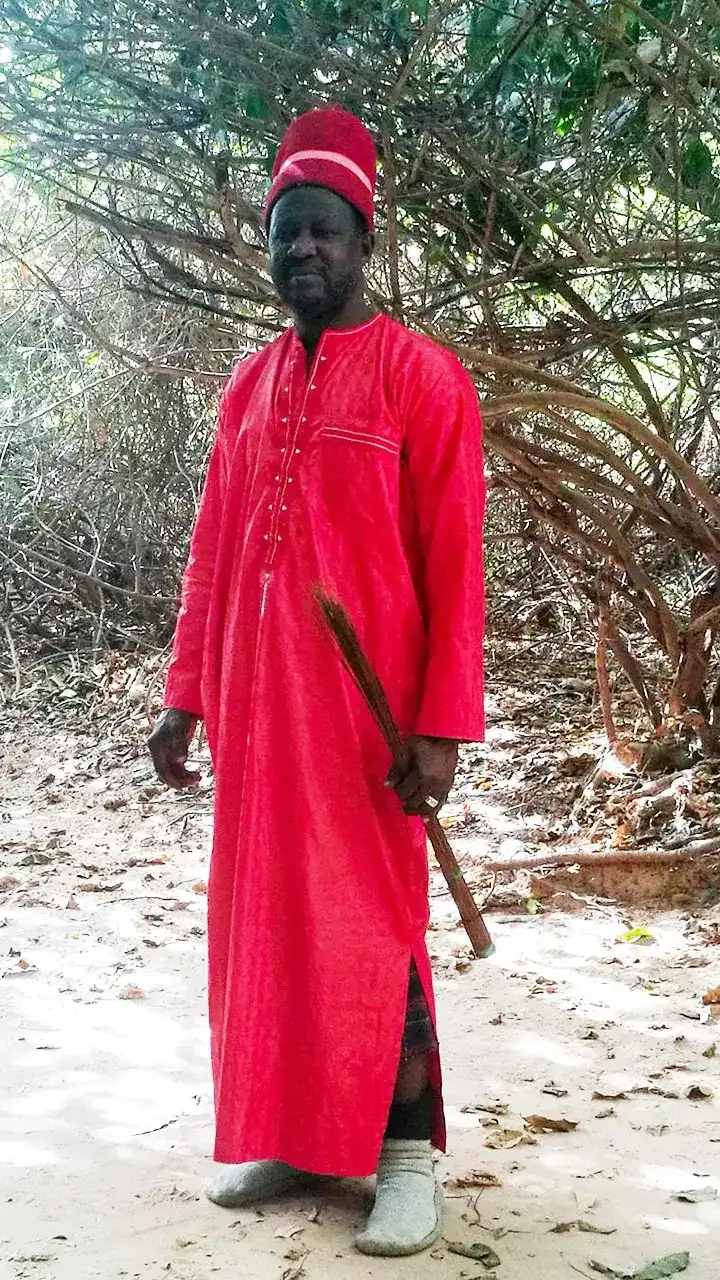
In red robes, his straw broom in hand
Meeting the King of Oussouye: an excursion into Jola culture from Cap Skirring
Oussouye is the capital of a sacred kingdom, one of the last in West Africa where an animist king, appointed by the elders, still watches over Jola traditions. From Cap Skirring, our excursion takes you to meet him, respecting custom and subject to his availability. To lengthen the day, there are three options: Joseph Patern’s artisanal cashew nut workshop, the potters’ village of Edioungou with lunch beside the mangrove, and, in the afternoon, a pirogue crossing to the island village of Éloubaline.
This page presents the excursion, what you discover in Oussouye, the protocol to respect, the options and our practical advice. It is part of our excursions in Casamance; if you are planning a longer trip, our complete guide to Casamance will help you put your stops together.
The excursion at a glance
- Format
- Short excursion by 4x4, which can be extended with three options
- Route
- Cap Skirring, then Oussouye (30 km, about 45 minutes by road)
- Meeting
- With the King of Oussouye, guardian of Jola traditions, subject to his availability; prepare your questions in advance
- Option 1
- Joseph Patern’s artisanal cashew nut workshop, in Oussouye
- Option 2
- The potters’ village of Edioungou and lunch at William Bassène’s, at the Les Bolongs camp: between 5,000 and 7,000 FCFA
- Option 3
- In the afternoon, by pirogue from Edioungou: visit to the island village of Éloubaline
- Dress
- Neat and modest: avoid red, the king’s colour
- Reserved for our guests
- For guests staying at Le Papayer Ecolodge
Like all our excursions in Casamance, this one is reserved for our guests, that is, people staying at Le Papayer Ecolodge: we do not run excursions for outside visitors. During your stay, the day is put together with you. To prepare it, request a call back or request your quote online.
The route: Cap Skirring, Oussouye and Edioungou
The day starts by 4x4 from Le Papayer Ecolodge. We drive to Oussouye, 30 kilometres away, in about 45 minutes. This is where the meeting with the king takes place, followed, as you wish, by a visit to Joseph Patern’s cashew nut workshop and to the potters’ village of Edioungou, a few kilometres away, beside a bolong. Lunch is at the Les Bolongs camp, at William Bassène’s, facing the mangrove; from there, a pirogue can take you in the afternoon to the island village of Éloubaline.
As the meeting is short, these options let you put together a half-day or a richer day. If you would like a full day, you can also combine it with our Pointe Saint-Georges and Mlomp excursion, which also goes through Oussouye.
Indicative map: landmarks and a simplified outline that does not show the exact route.
What you discover during the excursion
An excursion that is above all human and cultural. Here are its highlights:
- The King of Oussouye An animist sovereign, guardian of traditions, whom you meet in keeping with custom.
- The sacred grove The spiritual heart of the kingdom, where the king lives and which is not visited without an invitation.
- Cashew nuts Optional: an artisanal workshop at Joseph Patern’s, with a tasting.
- The potters of Edioungou Optional: an ancestral skill, handed down from mother to daughter.
- Lunch by the mangrove At William Bassène’s, at the Les Bolongs camp, between 5,000 and 7,000 FCFA.
- Éloubaline Optional, in the afternoon: an island village reached by pirogue.
The Kingdom of Oussouye, a sacred monarchy
South of the Casamance River, the Kingdom of Oussouye is one of the few sacred monarchies still alive in West Africa. The king holds no political power: he is a religious leader, a spiritual leader and the guardian of traditions. He is the link between the animist population, the spirits and the Jola supreme god, Ata Emit. He watches over peace and social cohesion, and helps settle disputes.
The present king, Mane Sibilumbaye Diédhiou (known as Olivier before his enthronement), was installed in January 2000. One becomes king not by election or inheritance: the elders consult the fetishes, which designate the person who is fit. Once designated, the king cannot withdraw from his duty. Before taking the throne, he worked in tourism, notably at the Club Med in Cap Skirring, where he was an entertainer (a “GO”). He lives in the sacred grove of Oussouye, an enclosed space entered only by invitation. He is recognised by his red robe and his straw broom, a symbol of his authority. Every year, after the harvest, a great festival brings the kingdom together.
The king has his own rice fields and is bound to help the most needy. According to local tradition, at night, people in need come and anonymously leave large empty bowls; they find them full again at dawn, filled with rice, thanks to the king, who thus brings comfort and food to those who need it.
Meeting the king: protocol and respect
You do not visit the King of Oussouye as you would a monument: it is a meeting, and it needs preparing. The audience is by invitation and depends on his availability; we take care of it for you, through our guide, who explains the customs and translates if needed. Sometimes the king cannot receive visitors that day: we then let you know and adapt the day around the options or another visit.
- Avoid red: it is the king’s colour. Wear neat, modest clothing, with shoulders and knees covered.
- Prepare your questions before the meeting: the king’s time is precious, and this is the best way not to waste it.
- Let your guide make the introductions and follow his instructions: the king receives you simply, seated on a wooden stool.
- According to local custom, an offering is brought; your guide will advise you on what is appropriate.
- Always ask permission before photographing the king, sacred places and people.
- The sacred grove cannot be visited: it is entered only by invitation, and no questions are asked about what happens there.
- Take the time to listen: it is a moment of dialogue about Jola culture, not a show.
Option 1: Joseph Patern’s artisanal cashew nut workshop
In Oussouye, we can stop at Joseph Patern’s, who makes cashew nuts by hand. He is related to Abbé Augustin Diamacoune Senghor, a figure of the Casamance movement. You see how the nut, which comes from the cashew apple, is harvested, shelled and prepared, before tasting it and taking home a local speciality.
In the bush, do not pick the fruit (cashew apples, lemons…) and do not touch the trees: the bush wasps and bees living there can sting at the slightest movement.
Option 2: Edioungou, the potters’ village, and lunch by the mangrove
Edioungou is a Jola village of Lower Casamance, in the rural community of Oukout, Oussouye department. It has about 300 inhabitants (304 at the 2002 census) and is regarded as a stronghold of traditional pottery. The village lies near a bolong, one of the mangrove channels that we present in our feature on the mangrove and the bolongs of Casamance.
Here, pottery is women’s work, and the skill is passed down from generation to generation. Clay and shells are gathered in the rainy season, then purified: the clay is pounded into powder, the shells are burnt and ground, and the two are mixed in equal parts and kneaded by hand until the paste is supple. Firing is done without a modern kiln, the pieces being surrounded with dry wood and rônier and palm leaves. After cooling, a varnish made from a local fruit gives them a glossy burgundy colour.
The visit lets you see these gestures up close and, if you wish, buy a piece directly from the potters: a useful souvenir and direct support for the village’s craft. Ask permission before taking photos.
Lunch is in Edioungou, at William Bassène’s, at the Les Bolongs camp, whose upstairs bar-restaurant overlooks the bolongs and the mangrove. Allow between 5,000 and 7,000 FCFA for the meal.
In the village, as a precaution, we recommend that you accept neither food nor drink apart from the meal planned at the camp, and that you follow your guide’s instructions.
Option 3: Éloubaline, the island village (in the afternoon)
From the Les Bolongs camp, in Edioungou, you can reach the village of Éloubaline by pirogue for an afternoon visit. Éloubaline is an island village in the rural community of Oukout, reached only by water: allow about an hour for the crossing through the mangrove. It has about 800 inhabitants (831 at the 2002 census) who live from rice growing and fishing.
You discover a Jola way of life shaped by the rice fields and the arms of the sea, and above all the impluvium houses: these large round earth houses, with a funnel-shaped roof that collects rainwater, can shelter several families. This option means allowing for the return by pirogue, then the road back to the lodge, so it is better suited to a full day.
A typical day to meet the King of Oussouye
Times are indicative: they adjust to the king’s availability and to the options you choose.
- Departure: by 4x4 from Le Papayer Ecolodge, heading for Oussouye.
- Road: 30 km, about 45 minutes.
- Oussouye: meeting with the king, respecting protocol.
- Option 1: Joseph Patern’s cashew nut workshop, with a tasting.
- Option 2: the potters’ village of Edioungou, demonstration and purchases possible; lunch at William Bassène’s, at the Les Bolongs camp.
- Option 3: in the afternoon, pirogue crossing (about an hour) to the village of Éloubaline.
- Return: to the lodge, at a time that suits you, in time for an evening swim in the ocean.
Practical advice for your excursion
- Prepare your questions before the meeting with the king, so as not to waste his precious time.
- In the villages, accept neither food nor drink apart from the planned meal, and follow your guide’s instructions.
- Wear neat, modest clothing, without red, for the meeting with the king.
- Bring a hat, sunscreen and water.
- Keep cash in small notes for purchases (cashew nuts, pottery) and tips.
- Always ask permission before photographing a person or a sacred place.
- In the bush, touch nothing: do not pick the fruit, do not lean on the trees, and touch neither plants nor flowers, at the risk of disturbing the bush wasps and bees.
- Listen to your guide: he knows the customs and makes the exchanges easier.
- The dry season (November to May) is the most comfortable; in the rainy season, we adapt the programme to the weather and the track.
Frequently asked questions about the King of Oussouye and the excursion
Who is the King of Oussouye?
He is the religious and spiritual leader of the animist Jola of the Oussouye region. He holds no political power: he is the guardian of traditions, watches over peace and social cohesion, and helps settle disputes. The present king is Mane Sibilumbaye Diédhiou.
Can you really meet the King of Oussouye?
Yes, by invitation and subject to his availability. We arrange the meeting with our guide, who knows the customs. If the king cannot receive visitors that day, we adapt the day.
How do you prepare to meet the king?
By preparing your questions in advance, so as not to waste his precious time, by avoiding red and by following the guide’s advice on customs.
How should you dress to meet the king?
Neat and modest, with shoulders and knees covered, and without red: it is the king’s colour.
Can you visit the sacred grove of Oussouye?
No, it is an enclosed space entered only by invitation. It houses the king’s residence and remains a place of worship.
Can you photograph the king?
Always ask permission before any photo, of him, of places or of people. Your guide tells you what is possible.
What do the options include?
The first is a visit to Joseph Patern’s artisanal cashew nut workshop, in Oussouye, with a tasting. The second is the potters’ village of Edioungou, with lunch at William Bassène’s, at the Les Bolongs camp. The third is, in the afternoon, the pirogue crossing to the island village of Éloubaline.
How is pottery made in Edioungou?
The women mix pounded clay with burnt, ground shells, knead the paste by hand, then fire the pieces in a fire of wood and rônier and palm leaves, before varnishing them with a local fruit, for a glossy burgundy colour.
Where do you have lunch and how much does it cost?
Lunch is in Edioungou, at William Bassène’s, at the Les Bolongs camp, facing the mangrove: allow between 5,000 and 7,000 FCFA.
How do you get to Oussouye from Cap Skirring?
By 4x4 from Le Papayer Ecolodge: allow about 45 minutes for the 30 kilometres.
Can you combine this excursion with Pointe Saint-Georges?
Yes, both go through Oussouye. We can put together a longer day with you; see our Pointe Saint-Georges and Mlomp excursion.
Is the excursion open to people who are not staying at the lodge?
No. All our excursions in Casamance are reserved for guests staying at Le Papayer Ecolodge: we do not organise excursions for outside visitors.
Can the King of Oussouye refuse his duty?
No: once designated by the elders, after consulting the fetishes, he cannot withdraw from his duty.
How do you get to Éloubaline?
By pirogue from Edioungou, through the mangrove: allow about an hour for the crossing. The village is on an island and can be reached only by water.
Going further: other excursions and features
Our other excursions from Cap Skirring: islands, bolongs, Jola villages and markets.
Carabane, the car-free island
A former colonial trading post at the mouth of the river: sandy lanes, a Breton-style church and lunch with your feet in the water.
The manatees of Pointe Saint-Georges
We go up the river to meet the manatees, and sometimes dolphins, before climbing a giant kapok tree.
The wild bolongs of Boudédiète
By pirogue, through the best-preserved arms of mangrove in the region.
Essaout, the oyster village
Trolling for fish, then a picnic of mangrove oysters picked from the roots.
Énampor, Jola architecture
The famous impluvium house: a huge round house of clay and thatch, designed to collect rainwater.
Affiniam and its bolong
Sailing and fishing in the bolong, then lunch in the village's great impluvium house.
Ziguinchor, capital of the South
The big city of Casamance: markets bursting with colour, crafts and the calm of the Alliance Française.
Niomoune and the Karone Islands
An island immersion by pirogue, far from everything, in the Karone archipelago.
Djembering and the giant of the savannah
The biggest kapok tree in Senegal, a place of gathering and stories, close to the lodge.
Cap Skirring, from market to nightfall
The village, its craft market, its colourful pirogues; and in the evening, dinner show and live music.
Our immersive excursions in Casamance on video
Come aboard in pictures: pirogues, bolongs, Jola villages and encounters, filmed during our excursions.
See all our excursions in Casamance
Understanding the region: our features on Casamance.
Fishing in Casamance
Artisanal fishing and major centres, the fisheries crisis and marine protected areas.
The mangrove & the bolongs
Mangrove trees, fish nursery, threats and replanting of this vital ecosystem.
Ecological protection & biodiversity
Ecosystems, protected areas and conservation strategies for a biodiversity unique to Casamance.
Forests & wood species
Exceptional flora, protected forests and sustainable management of forest resources.
Discover the Papayer Ecolodge Forest in Casamance
In Cap Skirring, discover the Papayer Ecolodge Forest, its one-hectare seaside grounds and its planting area. Plant a virtual tree or flower and explore our approach to protecting nature and biodiversity in Casamance.
DISCOVER THE PAPAYER ECOLODGE FOREST