Excursion from Cap Skirring to Pointe Saint-Georges: Manatees, Mlomp and a Sacred Kapok Tree
South of the Casamance River, Pointe Saint-Georges is one of the few places in Senegal where you can hope to spot the African manatee, the “mermaid of the river”. Our 4x4 day takes you there from Cap Skirring via Oussouye and the bush track, with cultural stops at Mlomp, a Jola village famous for its multi-storey houses and its museum: we have lunch at Louis’s, watch for manatees from the viewing platform at low tide, then you can climb the sacred kapok tree of Kanoufa for a view from 25 metres up.
This page presents the excursion, the route, the stops, how a typical day unfolds, the small budget to plan for on the spot and our practical advice. It is part of our excursions in Casamance; if you are planning a longer trip, our complete guide to Casamance will help you put your stops together.
The excursion at a glance
- Format
- Full day by 4x4, with several optional stops; departure in the morning after breakfast
- Route
- Cap Skirring, Oussouye (30 km, about 45 min), Mlomp (visits 1 h to 1 h 30), then the track to Pointe Saint-Georges (about 30 min); return via Oussouye
- Jola culture
- Multi-storey houses, rice granaries and the Jola museum of Mlomp; optional meeting with the fetish priests
- Manatees
- Viewing platform at low tide: sightings never guaranteed
- Sacred kapok tree
- Optional, secured climb (harness and safety belt) to the Kanoufa platform, over 25 metres up; allow 1 h to 1 h 30
- Lunch
- At Louis’s, at the manatee restaurant, facing the river: under 6,000 FCFA
- Return
- Early evening at the lodge, in time for an evening swim in the ocean
- Reserved for our guests
- For guests staying at Le Papayer Ecolodge
Like all our excursions in Casamance, this one is reserved for our guests, that is, people staying at Le Papayer Ecolodge: we do not run excursions for outside visitors. During your stay, the day is put together with you: the schedule depends on the tide, the season and what you feel like doing. To prepare it, request a call back or request your quote online.
The route: Oussouye, Mlomp and Pointe Saint-Georges
The day starts by 4x4 from Le Papayer Ecolodge. We drive through Oussouye (30 km, about 45 minutes by road), the capital of the Jola country of Lower Casamance, then stop at Mlomp to visit the multi-storey houses, the rice granaries and the Jola museum: allow 1 h to 1 h 30. We then take the track to Pointe Saint-Georges (about 30 minutes), on the Casamance River, which is also called “Punta” in the region.
Once there, we have lunch at Louis’s, at the manatee restaurant, then watch for manatees from the viewing platform. On the way back, if time allows, a stop in Oussouye lets you visit a small artisanal cashew nut workshop. The departure time is set by the tide, because low tide is when manatees can be spotted.
Indicative map: landmarks and a simplified outline that does not show the exact route.
What you discover during the day
A day that is both cultural and about nature. Here are its highlights:
- The multi-storey houses of Mlomp Striking Jola architecture, with its traditional rice granaries.
- The Jola museum Ritual objects, tools and stories of a living animist culture.
- The manatees Watched at low tide from the viewing platform, in silence and from a distance.
- The sacred kapok tree A platform over 25 metres up, taking in the countryside and the river.
- Lunch at Louis’s A simple, local meal facing the river, with tea to finish.
- Cashew nuts On the way back, an artisanal workshop in Oussouye, if time allows.
Mlomp: multi-storey houses, rice granaries and the Jola museum
Mlomp is a large Jola village in Lower Casamance, known for its multi-storey houses: earthen homes whose extra floor and covered terrace allow a whole family to live under one roof. Around them, the traditional rice granaries are a reminder that rice growing remains at the heart of Jola life. Visiting the multi-storey houses and granaries is paid, but there is no fixed fee: you give what you wish.
We continue to the Jola museum of Mlomp, set in a round house built around an impluvium, in the shade of large kapok trees. It displays objects from Jola animist culture: fetishes, fishing and gathering tools, pestles, amulets, hippopotamus-hide shields and musical instruments, with guides to explain them. Admission is also paid on the same principle: everyone gives what they wish. For both visits together (multi-storey houses, rice granaries and museum), 5,000 FCFA is a fair amount.
Meeting the fetish priests (optional)
If you wish, we can stop to meet the village’s fetish priests and pour a little wine to call upon the spirits, as custom dictates. It is a moment of respect rather than a show: follow your guide’s instructions, ask permission before taking photos and take the time to listen.
The African manatee, the “mermaid of the river”
The African manatee (Trichechus senegalensis) is a large, peaceful and discreet herbivorous aquatic mammal that can weigh several hundred kilos. A protected species, classed as vulnerable by the International Union for Conservation of Nature, it has become rare: Pointe Saint-Georges is among the few places in Senegal where it can still be observed.
The manatees are here because a freshwater spring wells up at this spot on the Casamance River. At low tide, we watch for them from the viewing platform, at a distance. But seeing a manatee cannot be scheduled: most often you glimpse a rounded back, then the paddle of the tail, before the animal dives again. Depending on the day and the season, you may see several or none. November to January is reputed to be the most favourable period. Whatever happens, the day remains rich: Mlomp, lunch, the kapok tree.
To understand what is at stake in conserving this animal and its habitat, read our feature on ecological protection and biodiversity in Casamance.
The sacred kapok tree of Kanoufa and its platform 25 metres up
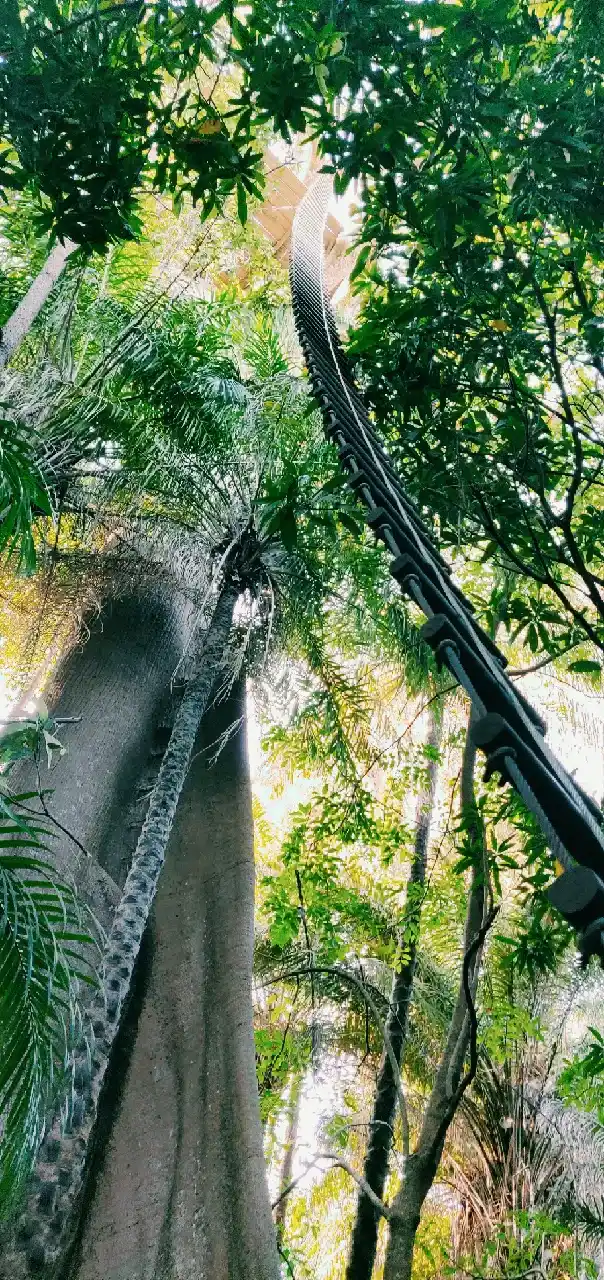
After lunch and tea, we can stop to climb the sacred kapok tree of Kanoufa (Ceiba pentandra), in the neighbouring forest. In Jola cosmology, this great tree links the living and the ancestors. A platform has been installed in it since 2008, over 25 metres up; according to the Senegalese press, the tree is more than 35 metres tall and nearly six centuries old.
Up there, the view takes in the Casamance countryside, the river and the mangrove. The climb is optional and paid: 3,000 FCFA, payable on the spot; we advise including it in the bill for lunch at Louis’s, which keeps things simple. It is very well secured: you are fitted with a harness and a safety belt. Allow 1 h to 1 h 30 for the ascent and for taking in the canopy and the bush, depending on the number of participants. If you hesitate or have a fear of heights, you can stay at the foot of the tree while the others climb.
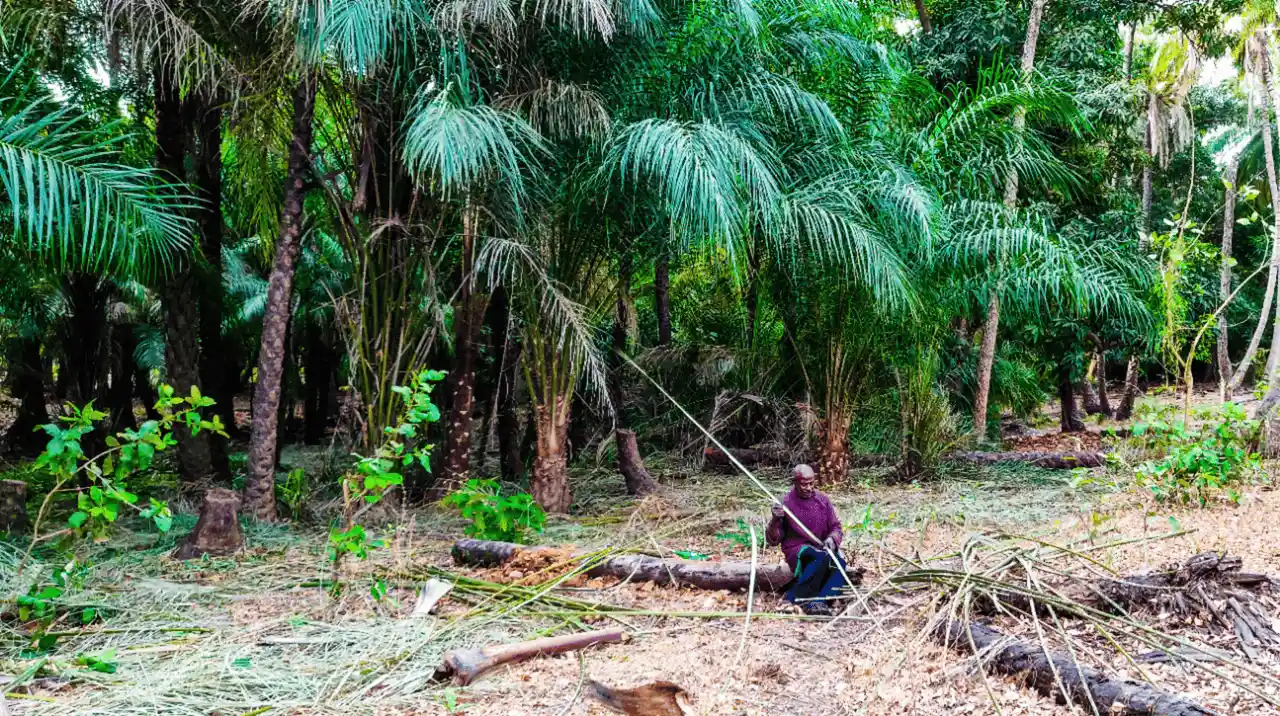
In the bush of Kanoufa, you may come across a bounoukeur, that is, a palm wine tapper (the “bounouk” in the Jola language), preparing his rônier palm fibre tools to climb and collect the sap of the palm trees: a beautiful subject for a photo, to be taken with his permission. On the way as well as at the top, avoid leaning on the tree or touching the vegetation: bush wasps and bees live there. To learn more about the great trees of the region, read our feature on forests and timber species of Casamance.
Pointe Saint-Georges: fishing village, lunch and shop
Pointe Saint-Georges is a fishing village on the left bank of the river, in the rural community of Mlomp, Oussouye department. It has about a hundred inhabitants (115 at the 2002 census) and lives from artisanal fishing. We have lunch there at Louis’s, at the manatee restaurant, facing the river: the meal costs under 6,000 FCFA, and tea follows. A break at Marie’s shop in the village is also possible.
The manatees remain fragile, and visitors’ discretion is part of their protection: speak in a low voice, do not throw anything in the water, do not try to approach them and follow your guide’s instructions. Their survival depends on the health of the river, which we present in our feature on the mangrove and the bolongs of Casamance.
Budget: what to plan for on the spot
Apart from the 4x4 day organised by the lodge, a few expenses are paid directly on the spot, in cash. The amounts below are indicative and may change:
- Lunch at Louis’s, at the manatee restaurant: under 6,000 FCFA.
- Mlomp, multi-storey houses, rice granaries and museum: no fixed fee, you give what you wish; 5,000 FCFA is a fair amount for the whole.
- Climbing the sacred kapok tree of Kanoufa: 3,000 FCFA, to be included in the lunch bill.
- Meeting the fetish priests (optional): bring a little wine for the libation, as is customary.
- Shops, cashew nuts, drinks: keep change in small notes.
A typical day at Pointe Saint-Georges
Times are indicative: they adjust to the tide and to your pace.
- Morning: departure by 4x4 from Le Papayer Ecolodge after breakfast, heading for Oussouye.
- Oussouye: 30 km, about 45 minutes by road.
- Mlomp: visit to the multi-storey houses and rice granaries, then the Jola museum (1 h to 1 h 30). Optionally, a meeting with the fetish priests and a wine libation.
- Track: about 30 minutes on the track to Pointe Saint-Georges.
- Lunch: at Louis’s, at the manatee restaurant, then tea; a break at Marie’s shop is possible.
- Manatees: watching from the viewing platform at low tide, in silence, and time to rest (allow 1 h to 1 h 30 including lunch).
- Sacred kapok tree: optional, secured climb (harness and safety belt) to the Kanoufa platform, over 25 metres up; 1 h to 1 h 30 depending on the number of participants.
- Return: if time allows, a stop in Oussouye for the cashew nut workshop; back at the lodge in the early evening, in time for an evening swim in the ocean.
On the way back: the artisanal cashew nut workshop in Oussouye
On the way back, if we have time, we stop in Oussouye at Joseph Patern’s, who makes cashew nuts by hand. He is related to Abbé Augustin Diamacoune Senghor, a figure of the Casamance movement. It is a short, friendly stop, where you can taste and take home a local speciality.
Practical advice for your excursion
- Silence and patience: these are the key to watching manatees, which show themselves only for a moment.
- Bring binoculars and a camera with a good zoom.
- Wear light closed shoes, suited to the track and to climbing the kapok tree.
- The climb up the kapok tree is secured (harness and safety belt) and optional; it is still not recommended for people prone to vertigo.
- Bring a hat, sunscreen and water.
- Keep cash in small notes (lunch, visits, kapok tree, shops).
- In Mlomp, respect the places: always ask permission before photographing a person or a sacred place.
- In the bush, touch nothing: do not pick the fruit (lemons, cashew apples…), do not lean on the trees, and touch neither plants nor flowers. The slightest movement or vibration can disturb the bush wasps and bees living in the trees, and lead to stings. Stay on the path and follow your guide.
- Do not throw rubbish or food into the water, and do not approach the animals.
- The dry season (November to May) is the most comfortable; in the rainy season, we adapt the programme to the weather, the track and the tide.
Frequently asked questions about Pointe Saint-Georges, Mlomp and the manatees
Are you sure to see manatees at Pointe Saint-Georges?
No, and we prefer to say so clearly: sightings depend on the tide, the season and chance. You generally glimpse a back and a tail at the surface, briefly. Some days you see several, others none; the day remains rich thanks to Mlomp, lunch and the kapok tree.
Why are there manatees at Pointe Saint-Georges?
Because a freshwater spring wells up at this spot on the Casamance River. Low tide is when you can watch for them from the viewing platform.
What is the best time to see manatees?
The dry season, from November to May, is the most pleasant. Sightings are reputed to be more frequent from November to January, at low tide.
How do you get to Pointe Saint-Georges from Cap Skirring?
By 4x4, via Oussouye (30 km, about 45 minutes) and Mlomp, then along the track (about 30 minutes) to the village. The day includes several stops, and the return is in the early evening.
How long does the day last?
After breakfast, allow about 45 minutes to Oussouye, 1 h to 1 h 30 of visits in Mlomp, about 30 minutes of track to the Pointe, then lunch, manatee watching and rest. The kapok tree climb takes 1 h to 1 h 30 depending on the group. You are back at the lodge in the early evening.
What do you visit in Mlomp?
The multi-storey houses, the traditional rice granaries and the Jola museum. The visit is paid, with no fixed fee: you give what you wish, and 5,000 FCFA is a fair amount for the whole.
How much do lunch and the kapok tree climb cost?
Lunch at Louis’s, at the manatee restaurant, costs under 6,000 FCFA. Climbing the sacred kapok tree of Kanoufa costs 3,000 FCFA, which can be included in the lunch bill. These amounts are indicative.
Are there precautions to take in the bush?
Yes: do not touch the fruit (lemons, cashew apples…), do not lean on the trees, and touch neither plants nor flowers. Movements and vibrations can disturb the bush wasps and bees living in the trees and lead to stings. Follow your guide’s instructions.
Is climbing the sacred kapok tree compulsory?
No, it is optional. The platform is over 25 metres up and the climb is very well secured (harness and safety belt). Allow 1 h to 1 h 30 depending on the number of participants; people prone to vertigo can stay at the foot of the tree.
Can you meet the fetish priests of Mlomp?
Yes, optionally: we can stop in the village to meet the fetish priests and make a libation of a little wine to call upon the spirits. It is a moment of respect, to be experienced with discretion.
Is the excursion open to people who are not staying at the lodge?
No. All our excursions in Casamance are reserved for guests staying at Le Papayer Ecolodge: we do not organise excursions for outside visitors.
Where is Pointe Saint-Georges?
It is a fishing village on the left bank of the Casamance River, in Lower Casamance, in the rural community of Mlomp, Oussouye department.
Going further: other excursions and features
Our other excursions from Cap Skirring: islands, bolongs, Jola villages and markets.
Carabane, the car-free island
A former colonial trading post at the mouth of the river: sandy lanes, a Breton-style church and lunch with your feet in the water.
The wild bolongs of Boudédiète
By pirogue, through the best-preserved arms of mangrove in the region.
Essaout, the oyster village
Trolling for fish, then a picnic of mangrove oysters picked from the roots.
An audience with the King of Oussouye
A rare meeting with the King of Oussouye, guardian of Jola traditions, then a small cashew nut workshop.
Énampor, Jola architecture
The famous impluvium house: a huge round house of clay and thatch, designed to collect rainwater.
Affiniam and its bolong
Sailing and fishing in the bolong, then lunch in the village's great impluvium house.
Ziguinchor, capital of the South
The big city of Casamance: markets bursting with colour, crafts and the calm of the Alliance Française.
Niomoune and the Karone Islands
An island immersion by pirogue, far from everything, in the Karone archipelago.
Djembering and the giant of the savannah
The biggest kapok tree in Senegal, a place of gathering and stories, close to the lodge.
Cap Skirring, from market to nightfall
The village, its craft market, its colourful pirogues; and in the evening, dinner show and live music.
Our immersive excursions in Casamance on video
Come aboard in pictures: pirogues, bolongs, Jola villages and encounters, filmed during our excursions.
See all our excursions in Casamance
Understanding the region: our features on Casamance.
Fishing in Casamance
Artisanal fishing and major centres, the fisheries crisis and marine protected areas.
The mangrove & the bolongs
Mangrove trees, fish nursery, threats and replanting of this vital ecosystem.
Ecological protection & biodiversity
Ecosystems, protected areas and conservation strategies for a biodiversity unique to Casamance.
Forests & wood species
Exceptional flora, protected forests and sustainable management of forest resources.
Discover the Papayer Ecolodge Forest in Casamance
In Cap Skirring, discover the Papayer Ecolodge Forest, its one-hectare seaside grounds and its planting area. Plant a virtual tree or flower and explore our approach to protecting nature and biodiversity in Casamance.
DISCOVER THE PAPAYER ECOLODGE FOREST