Niomoune Excursion from Cap Skirring: Pirogue Through the Bolongs and a Night at the Alouga Camp
On the far side of the Casamance River, on its north bank, Niomoune Island is a world apart, reached only by pirogue. Our excursion takes you there from Cap Skirring: 4x4 to the Bouyouye landing stage, then a long crossing through the bolongs, with Carabane on your left, before a night at the Alouga camp. It is our longest, most expensive and most complicated excursion to organise, but also the most out of the ordinary. Niomoune opens the door to the Karone Islands and the Karoninka world, for those who want to go further. It also works very well at the end of a stay: spend a few nights at the lodge first, then set off for Niomoune and continue on through the Karones.
This page presents the excursion, the route, the island, the camp, the Karone Islands and our practical advice. It is part of our excursions in Casamance; if you are planning a longer trip, our complete guide to Casamance will help you put your stops together.
The excursion at a glance
- Format
- Two days and one night: 4x4, long pirogue ride, night at the Alouga camp
- Route
- By 4x4 from Le Papayer Ecolodge to the Bouyouye landing stage
- Pirogue
- From Bouyouye to Niomoune, on the north bank of the river: about 2 hours through the bolongs
- Lunch on the way back
- Stop at Cachouane, at the Sounka camp, run by Papis
- Night
- At the Alouga camp, with Hyacinthe (Yas), a son of the village
- What to bring
- A backpack, for the night
- Budget
- Our most expensive excursion: about 150,000 FCFA for the pirogue (fuel and boatman), plus the night and the meals at the camp
- Who it is for
- Young children and babies cannot take part
- Going further
- The Karone Islands, Itou and Diogué: at least two more days, by pirogue; for the more adventurous, you can even reach Kassel and head back up towards Kafountine and Abéné
- At the end of a stay
- Ideal for extending your discovery: a few nights at the lodge, then this excursion, then the road on through the Karones
- Initiation festival
- Every 10 to 15 years or so in the Karones: a spectacle not to be missed when one is scheduled
- Reserved for our guests
- For guests staying at Le Papayer Ecolodge
Like all our excursions in Casamance, this one is reserved for our guests, that is, people staying at Le Papayer Ecolodge: we do not run excursions for outside visitors. The night at the camp has to be arranged in advance: remember to book early. To prepare the excursion, request a call back or request your quote online.
The route: from Bouyouye to Niomoune, through the bolongs
The journey starts with a 4x4 from Le Papayer Ecolodge to the Bouyouye landing stage. You then board a pirogue and head up towards Cachouane. The island of Carabane stays on your left, then the pirogue turns towards Ziguinchor and Pointe Saint-Georges. A little before Punta, you enter the Niomoune bolong, which winds its way to the island.
It is a very beautiful ride along the bolongs of Casamance, but a long one: the crossing takes about 2 hours. That is why we sleep on site, at the Alouga camp, and why we plan for backpacks rather than suitcases.
Indicative map: landmarks and a simplified line, which does not show the exact route.
What you discover during the excursion
Two days drifting along the water, between mangrove, rice fields and island life. Here are the highlights:
- The track to Bouyouye The 4x4 departure, to the landing stage on the bolongs.
- The pirogue crossing Cachouane, Carabane on the left, Pointe Saint-Georges, then the Niomoune bolong.
- Niomoune Island A Jola village of about 1,700 inhabitants and its four neighbourhoods: a good day's visit in itself.
- The Alouga camp A night in mud-brick huts, with meals shared with the family and fellow travellers.
- The shell mounds Hills of shells, some of them sacred, and paths covered with shells.
- The Karone Islands Boon, Illol, Kuba and Saloulou: the Karoninka world, which begins here, with Itou and Diogué on the way.
- The initiation festival A rare ceremony, held every 10 to 15 years or so: the young men come out of the sacred wood, as men.
The crossing: hours by pirogue through the bolongs
From Bouyouye, the pirogue heads up towards Cachouane, at the mouth of the river. Carabane stays on the left, then the boat runs towards Ziguinchor and Pointe Saint-Georges. Before passing Punta, it takes the Niomoune bolong, a narrow waterway that winds between the mangroves to the island. The entrance to the village is not visible right away: the boatman knows the way. To better understand these landscapes, read our feature on the mangrove and the bolongs of Casamance. Carabane and Pointe Saint-Georges each have their own excursion: see the Carabane excursion and the Pointe Saint-Georges excursion.
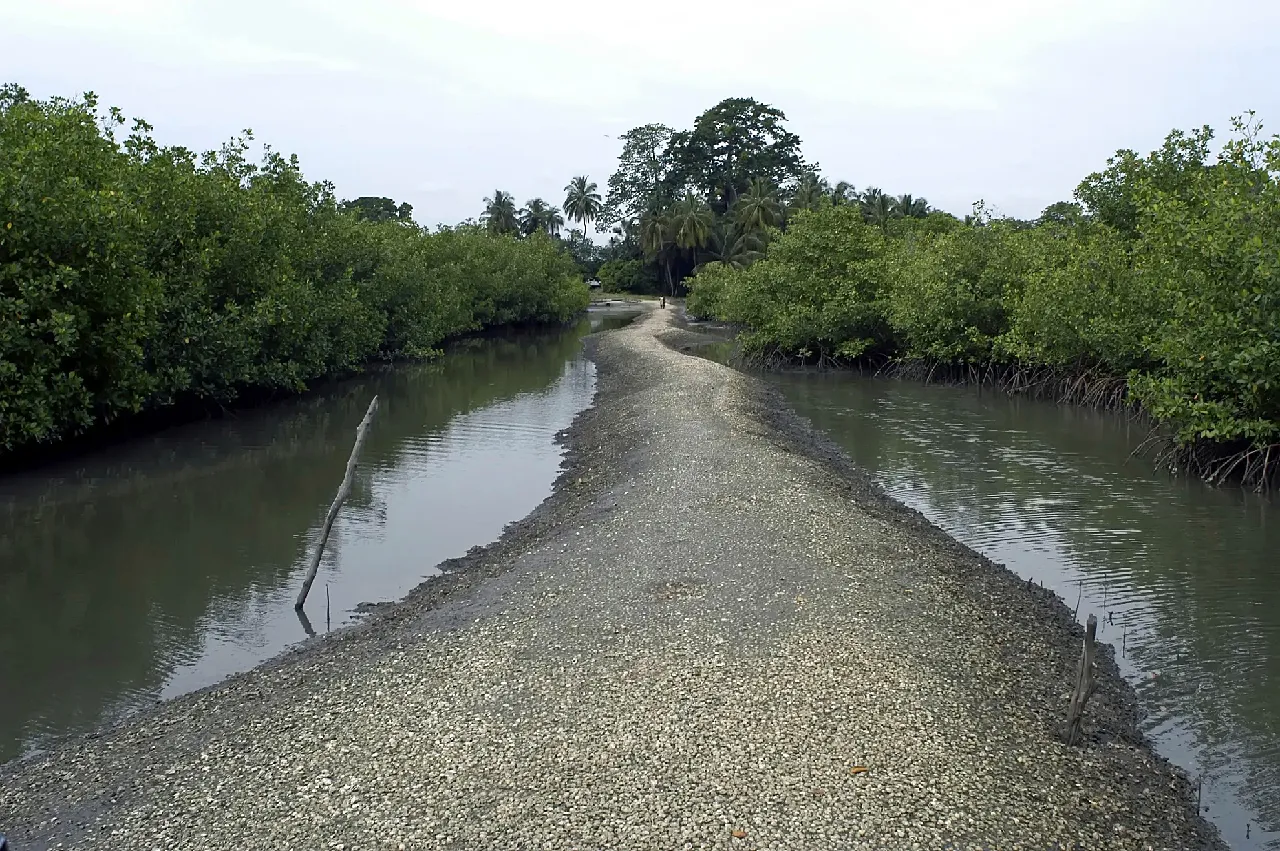
The crossing takes about 2 hours. It is beautiful, but long, and the light on the water is bright: bring a hat, sunscreen and plenty of water. On the way back, we stop at Cachouane for lunch at the Sounka camp, run by Papis. The price of the pirogue, about 150,000 FCFA, includes the fuel and the boatman.
Niomoune: a Jola island at the end of the bolongs
Niomoune lies on the north bank of the Casamance River, in the Bignona department. At the 2002 census the island had 1,663 inhabitants and 231 households, spread over four neighbourhoods. It is surrounded by rice fields and mangrove, linked by earth dikes, and life there revolves around rice growing, fishing and managing fresh and salt water.
Visiting the village of Niomoune is a good day in itself: you walk through its four neighbourhoods, Elou, Somme, Essagholu and Ouback, each with its own character and its own gathering place. The Elou neighbourhood is home to the school, the secondary school and the church; the villagers' common house stands near the quay.
You get around on foot, on paths covered with shells. The inhabitants, who are Jola, blend animism and Christianity, and you will see baobabs and a church. Archaeologists have long been interested in the island: it has several shell mounds, hills formed by centuries of shells, two of which are sacred. Dating places the oldest in the first centuries of our era. As on other shores of Lower Casamance, erosion threatens some sites.
The Alouga camp: a night with Hyacinthe, known as Yas
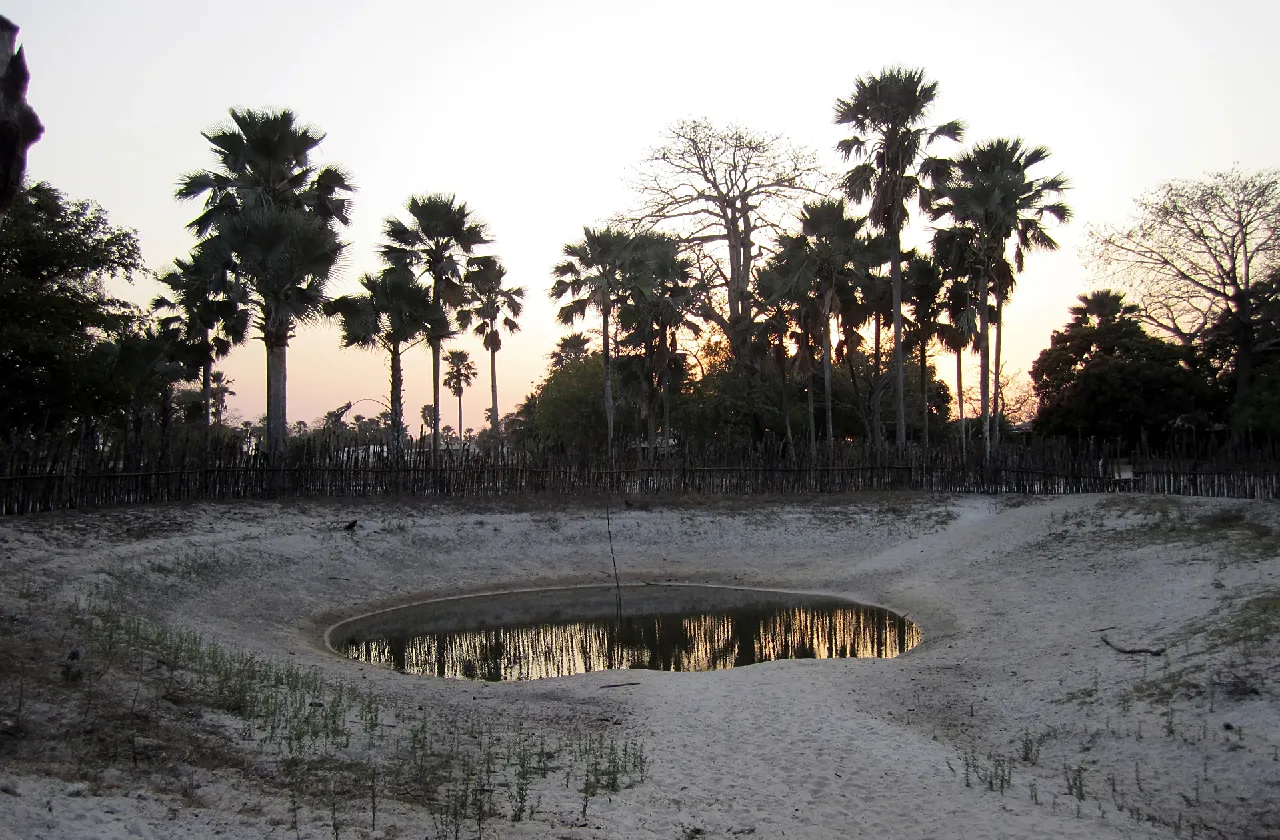
Alouga is the Jola name for the fishing bird, the kingfisher. The camp stands in the middle of the rice fields, beside a bolong. It was created by Hyacinthe Diedhiou, known as Yas, to come back and live in his home village, keep Jola culture alive and create jobs. Accommodation is in banco huts, banco being traditional raw earth, with shared toilets and solar electricity; sun-heated water is used for a bucket shower, African style.
Meals are eaten at a shared table, with fresh local produce: grilled fish and seafood, oysters, Senegalese specialities, as well as bread and homemade jams at breakfast. Yas can also guide visitors around the island. Nights and meals are to be paid on top of the pirogue.
Going further: the Karone Islands, Itou and Diogué
Niomoune is the gateway to the Karone Islands: Boon, Illol, Kuba and Saloulou. It is another world, that of the Karoninka, a people related to the Jola who live on the north bank of the river and on its islands, and who speak Karon. These islands are said to be one of the great centres of animism in Casamance, with their sacred woods and ancient traditions. There are no cars at all: everything is done by pirogue or on foot.
The door is open, but it takes at least two more days to visit the villages of the Karones. The island of Illol, also spelled Hilol, is famous for having resisted French troops in two battles in 1859 and 1860.
Two other stops can be combined with this excursion, opposite the island of Carabane. Itou, on the north bank at the mouth of the river, is the first place in Casamance where the French flag was raised, in 1828.
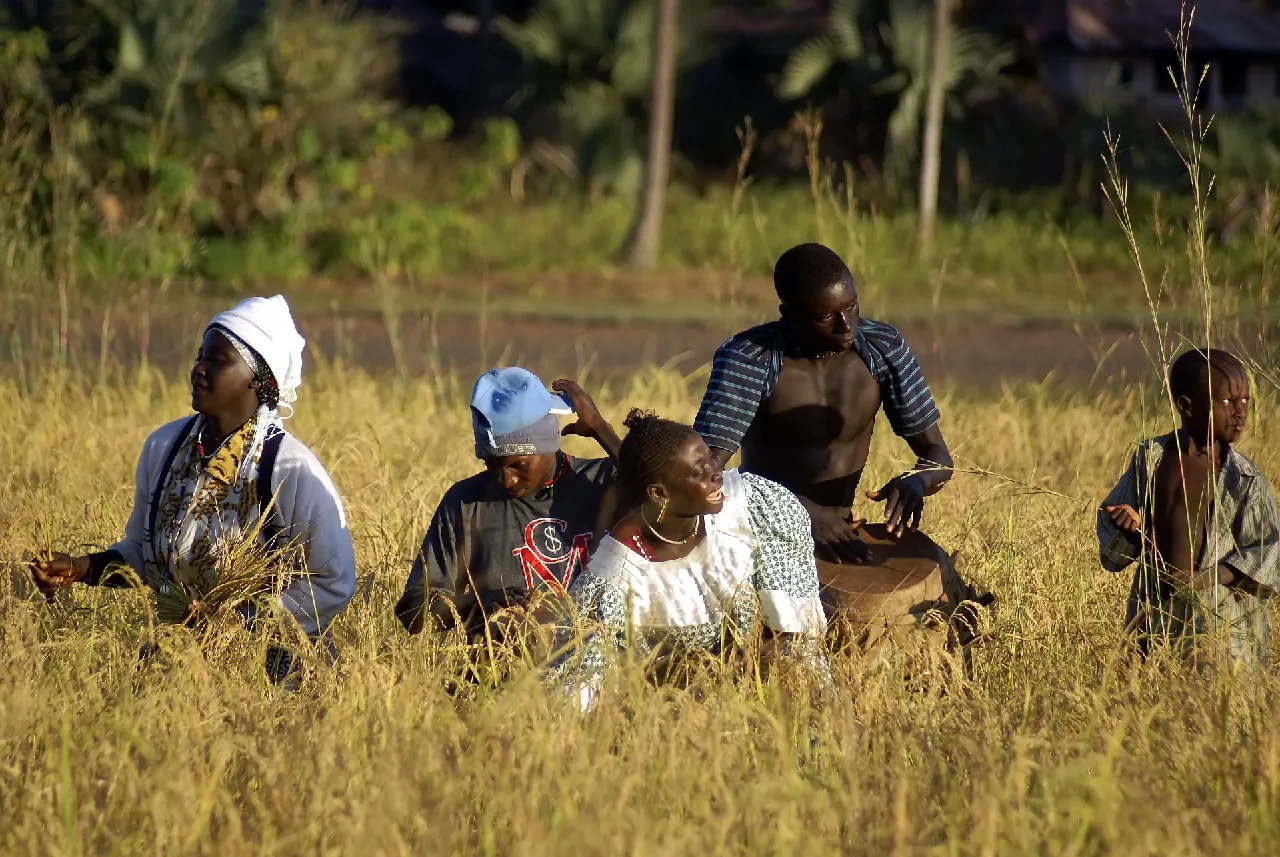
Diogué is an island at the river mouth, with about 1,000 inhabitants, a Wolof neighbourhood and a Jola neighbourhood, and a way of life turned towards fishing.
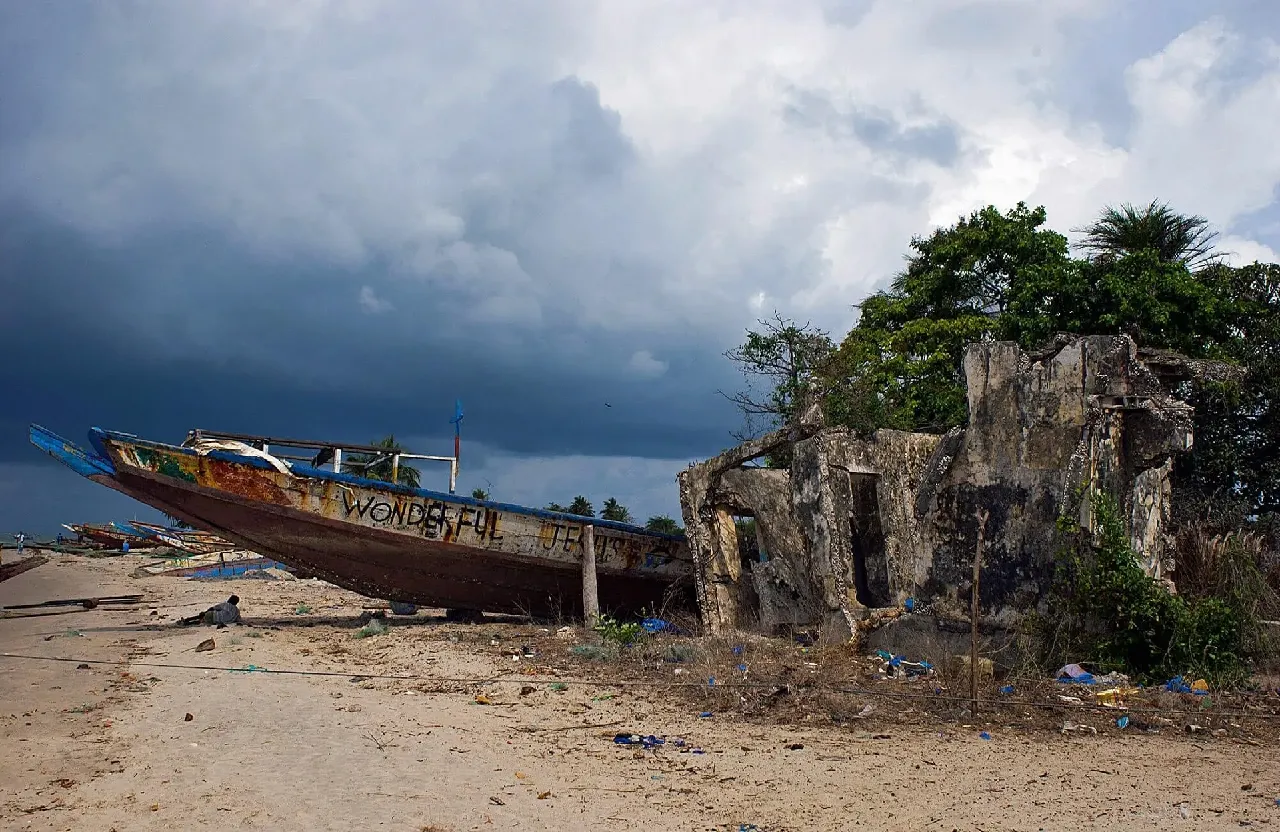
For the more adventurous, it is possible to reach Kassel, the departure point for the Karones, then head back up towards Kafountine and Abéné, two beautiful villages on the north coast. Kafountine, a fishing village of about 4,200 inhabitants at the 2002 census, is where pirogues leave for the Karones, through the bolongs. Abéné, smaller, hosts a djembe festival every year, the Abéné Festivalo. On request, we can also arrange a picnic on the wild beach of Katy.
Finally, this excursion can round off a stay with us: travellers who want to extend their discovery of Casamance spend a few nights at the lodge first, then we organise the Niomoune excursion for them at the end of their stay, and they continue on their way through the Karones.
It is the most complicated excursion to organise, and the wildest: it is meant for true adventurers. The basic option remains one night with Yas; tell us what you have in mind before booking.
The initiation festival: a spectacle not to be missed
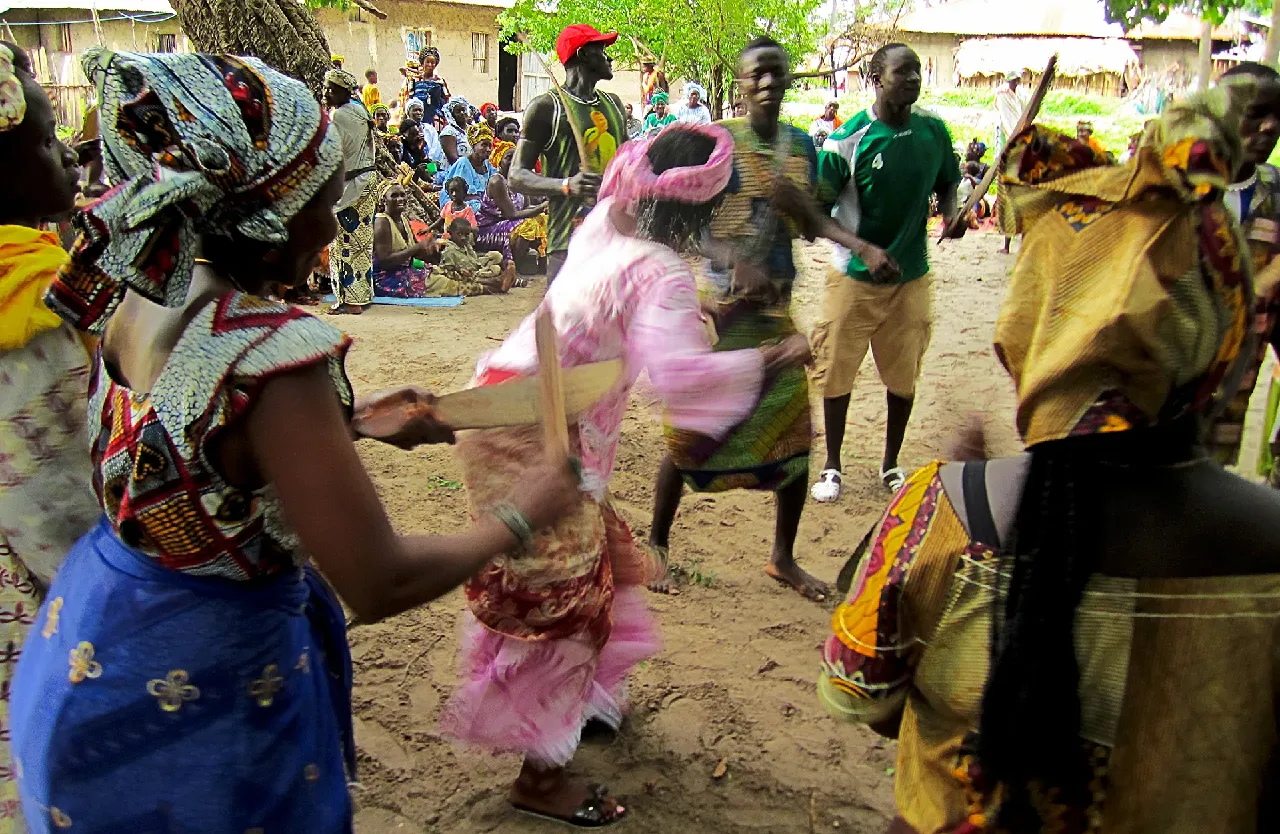
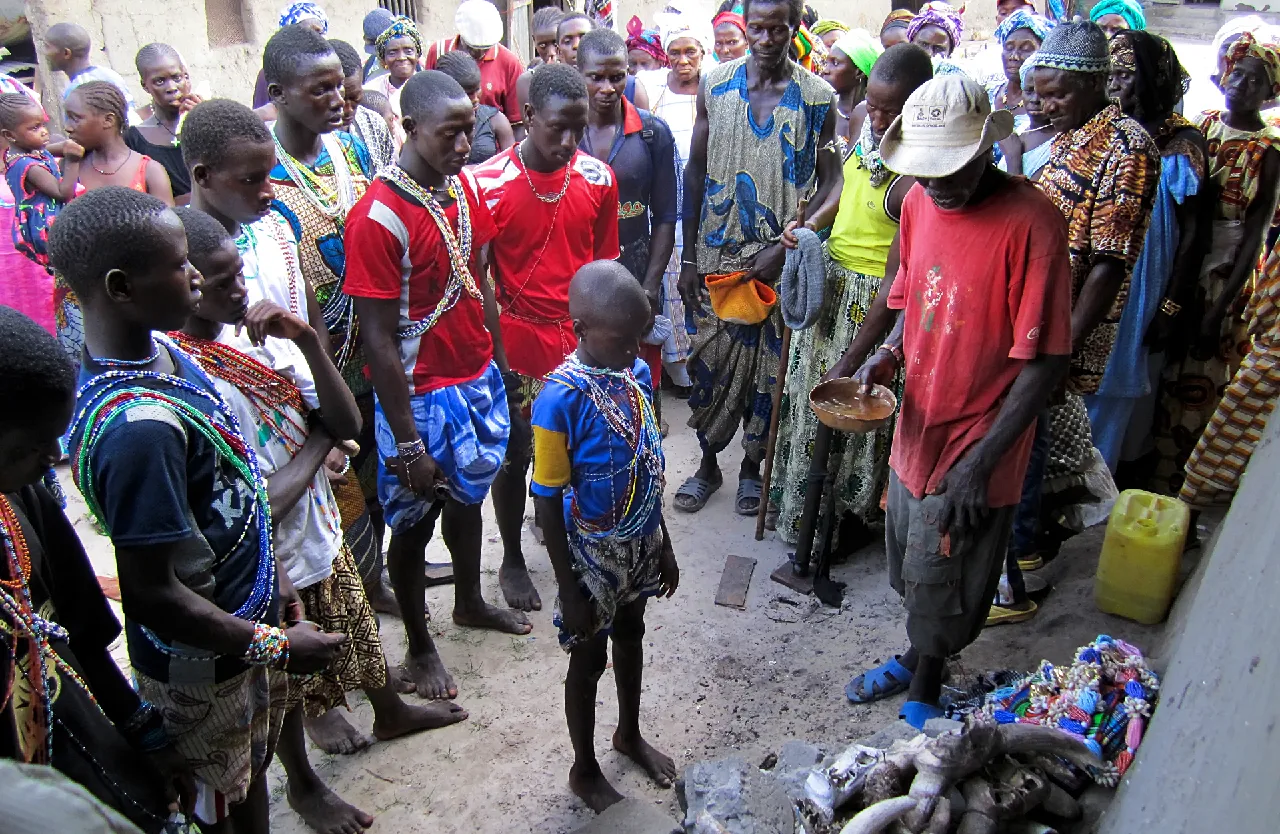
In the villages of the Karone Islands, such as Illol and Niomoune, the initiation festival is the great moment of the animist Jola tradition. Initiation, called bukut or boukout by the Jola, marks the passage from adolescence to manhood: the young people enter the sacred wood, a place reserved for the initiated, where the elders pass on spiritual and cultural teaching, along with rites that include circumcision. They come out as men, recognised as such by the community, and their emergence is celebrated with a great festival of dancing and singing.
These ceremonies are rare: in the Karones they are held only every 10 to 15 years or so, on a date decided by the elders. It is therefore impossible to know when the next ones will take place. But when they are scheduled, it is a spectacle not to be missed. If your stay coincides with one of them, tell us so that we can adapt the excursion.
The sacred wood and its rites remain secret: you attend the festival, not the initiation itself. Out of respect, always ask permission before taking photographs and follow your guide's instructions.
A typical stay: two days and one night
Times are given as a guide: they adjust to the tide and to your pace.
- Day 1, departure: by 4x4 from Le Papayer Ecolodge, early in the morning, to the Bouyouye landing stage.
- Pirogue: Cachouane, Carabane on the left, Pointe Saint-Georges, then the Niomoune bolong.
- Arrival: welcome at the Alouga camp, settling in, a walk around the island.
- Evening: dinner at the shared table and a night in a banco hut.
- Day 2: morning on the island, then back the same way by pirogue.
- Lunch: stop at Cachouane, at the Sounka camp, run by Papis.
- Return: pirogue to Bouyouye, then 4x4 to the lodge.
Practical advice for your excursion
- At the end of a stay: this is the right moment for this excursion if you want to continue on to the Karones; tell us when you book.
- Not for little ones: young children and babies cannot take part in this excursion.
- A backpack, not a suitcase: the crossing is long and you sleep on site. Leave the rest at the lodge.
- Bring a hat, sunscreen, water, sunglasses and mosquito repellent.
- Plan a headlamp, light clothing and a sweater for the pirogue.
- Keep cash in small notes for the nights, the meals and purchases on the island.
- Let us know early: the camp must be told you are coming.
- Ask permission before photographing the inhabitants, and respect sacred places, such as the sacred shell mounds.
- Do not throw any waste into the water or on the island.
- In the bush, do not pick fruit, do not lean on trees and do not touch flowers: bush wasps and bees live there.
- The dry season (November to May) is the most comfortable; in the rainy season, we adapt the programme to the weather and the tide.
Frequently asked questions about the Niomoune excursion
Where is Niomoune?
On the north bank of the Casamance River, on an island of Lower Casamance, across from Cap Skirring, in the Bignona department. It can only be reached by pirogue.
How do you get to Niomoune from Cap Skirring?
By 4x4 from Le Papayer Ecolodge to the Bouyouye landing stage, then by pirogue through the bolongs, via Cachouane, Carabane on the left and Pointe Saint-Georges, before entering the Niomoune bolong.
How long does the pirogue crossing take?
About 2 hours from Bouyouye to Niomoune: it is a beautiful ride, but a long one. That is why the excursion takes two days, with a night on site.
Where do you have lunch on the way back?
At Cachouane, where we stop at the Sounka camp, run by Papis, a camp set in an impluvium house, with a Senegalese restaurant serving fresh local produce.
Why spend the night on site?
Because the crossing is long and the island is worth staying for. You sleep at the Alouga camp, with Hyacinthe, known as Yas.
How much does the Niomoune excursion cost?
It is our most expensive excursion: about 150,000 FCFA for the pirogue (fuel and boatman), plus the night and the meals at the camp.
What does Alouga mean?
Alouga is the Jola name for the fishing bird, the kingfisher. It is also the name of the camp where you sleep.
Where do you sleep and what do you eat?
At the Alouga camp, in banco huts, with solar electricity. You eat at a shared table with fresh local produce: grilled fish and seafood, oysters, homemade bread and jams.
What should you bring?
A backpack, not a suitcase: light clothing, hat, sunscreen, water, mosquito repellent, a headlamp and small notes in cash.
What are the Karone Islands?
A group of islands in the Casamance estuary, including Boon, Illol, Kuba and Saloulou, inhabited by the Karoninka, a people related to the Jola who speak Karon. Niomoune is the gateway to them; there are no cars, everything is done by pirogue.
Can you visit the Karone Islands from Niomoune?
Yes, but it takes at least two more days to visit the villages of the Karones. It is an option for true adventurers; the basic option remains one night with Yas.
What is the initiation festival?
It is the great ceremony of the animist Jola tradition, called bukut or boukout: the young people enter the sacred wood, where the elders pass on spiritual and cultural teaching and the rites of passage, including circumcision, then come out as men. Their emergence is celebrated with a festival of dancing and singing.
When is the next initiation festival?
There is no way of knowing in advance: in the Karones it is held only every 10 to 15 years or so, on a date decided by the elders. When a ceremony is scheduled, it is a spectacle not to be missed: tell us when you book.
What can you see at Itou and Diogué?
Itou, on the north bank at the river mouth, opposite Carabane, is the first place in Casamance where the French flag was raised, in 1828. Diogué is an island at the river mouth, with about 1,000 inhabitants, a Wolof neighbourhood and a Jola neighbourhood, living from fishing.
What is there to see in Niomoune itself?
Visiting the village is a good day in itself: you walk through its four neighbourhoods, Elou, Somme, Essagholu and Ouback, its rice fields, its shell paths and its shell mounds.
Can you do this excursion at the end of a stay?
Yes, it is even a good plan: you spend a few nights at the lodge, then we organise the Niomoune excursion at the end of the stay, and you continue on through the Karones. Tell us when you book.
Can you go as far as Kafountine and Abéné?
Yes, for the more adventurous: you reach Kassel, then head back up towards Kafountine and Abéné, two beautiful villages on the north coast. We can also arrange a picnic on the wild beach of Katy.
Can children take part?
Young children and babies cannot take part in this excursion: the crossing is long and the organisation is complicated.
Who are the Karoninka?
A people related to the Jola, settled on the north bank of the Casamance River and on its islands. They speak Karon and are said to be very attached to their animist traditions.
What is a shell mound?
A hill formed by the accumulation of shells (oysters, ark clams) eaten over centuries. At Niomoune, several mounds have been studied by archaeologists and two are sacred.
Is the excursion open to people who are not staying at the lodge?
No. All our excursions in Casamance are reserved for guests staying at Le Papayer Ecolodge: we do not organise excursions for outside visitors.
Going further: other excursions and features
Our other excursions from Cap Skirring: islands, bolongs, Jola villages and markets.
Carabane, the car-free island
A former colonial trading post at the mouth of the river: sandy lanes, a Breton-style church and lunch with your feet in the water.
The manatees of Pointe Saint-Georges
We go up the river to meet the manatees, and sometimes dolphins, before climbing a giant kapok tree.
The wild bolongs of Boudédiète
By pirogue, through the best-preserved arms of mangrove in the region.
Essaout, the oyster village
Trolling for fish, then a picnic of mangrove oysters picked from the roots.
An audience with the King of Oussouye
A rare meeting with the King of Oussouye, guardian of Jola traditions, then a small cashew nut workshop.
Énampor, Jola architecture
The famous impluvium house: a huge round house of clay and thatch, designed to collect rainwater.
Affiniam and its bolong
Sailing and fishing in the bolong, then lunch in the village's great impluvium house.
Ziguinchor, capital of the South
The big city of Casamance: markets bursting with colour, crafts and the calm of the Alliance Française.
Djembering and the giant of the savannah
The biggest kapok tree in Senegal, a place of gathering and stories, close to the lodge.
Cap Skirring, from market to nightfall
The village, its craft market, its colourful pirogues; and in the evening, dinner show and live music.
Our immersive excursions in Casamance on video
Come aboard in pictures: pirogues, bolongs, Jola villages and encounters, filmed during our excursions.
See all our excursions in Casamance
Understanding the region: our features on Casamance.
Fishing in Casamance
Artisanal fishing and major centres, the fisheries crisis and marine protected areas.
The mangrove & the bolongs
Mangrove trees, fish nursery, threats and replanting of this vital ecosystem.
Ecological protection & biodiversity
Ecosystems, protected areas and conservation strategies for a biodiversity unique to Casamance.
Forests & wood species
Exceptional flora, protected forests and sustainable management of forest resources.
Discover the Papayer Ecolodge Forest in Casamance
In Cap Skirring, discover the Papayer Ecolodge Forest, its one-hectare seaside grounds and its planting area. Plant a virtual tree or flower and explore our approach to protecting nature and biodiversity in Casamance.
DISCOVER THE PAPAYER ECOLODGE FOREST